Become a Member for as little as the price of a croissant and enjoy unlimited reading of TSLL blog. Add the cost of your favorite cuppa and enjoy ad-free reading site-wide, including all exclusive content.
Scarves. Year-round, seen on the streets of Paris and many other European cities, scarves drape, wrap, tuck into the ensembles of women, men and children alike.
One of the many things that captures my awe each time I travel to both continental Europe and Britain is the ubiquity of scarves. All of which are worn for utilitarian purposes, yet simultaneously finish any outfit seamlessly without being the star.
During the summer, even in Provence, scarves are seen wrapping necks in the early morning or late evening. Linen being the fabric of choice to keep the body cool. In the frigid damp air of winter in London, wool and cashmere bundle passersby, and all the scarves seem to be wrapped with ease, yet still have a precision of style unforgotten.
For many years, I have been in awe of the artistry of tying silk scarves, in particular the foulards, the narrow, small silk scarves, sometimes called neckerchiefs. And part of my confusion was thinking I had to purchase a square silk scarf, sometimes called a gavroche, to create the look I wished to achieve. Which leads me to why I wanted to include a dedicated post in this series to scarves. There is no reason for scarves to be complicated in their tying. For too long, I, and maybe you too, was a bit intimidated by the art of tying a scarf to actually give it a wholehearted try. The long rectangular scarves for winter and linen (similar size) were quickly mastered, but the silk scarf around my neck, I basically decided to cede defeat. But that was the problem, I didn’t have the right fabric nor the right design to help myself out.
However, giving up is not in my nature, so I kept trying to figure out how to simplify, yet still create the style/look I so admired (some great looks of everyday style wearing a foulard are seen in Camilla Läckberg’s Erica mystery series streaming on MHzChoice (set in Brittany, France).
So today, I won’t be sharing with you the fancy, artistic ways to tie your scarves (the basic everyday approaches – absolutely). What I will be sharing, along with the many types of scarves and where to find them, is which scarf to purchase so that you don’t have to tie yourself up in knots (pun intended) or try to try and reverse the mirror tutorials in your mind to create the same look. That is what will make the difference. Will you have to invest? Yep, but, maybe not as much as you would think, and if you know what you want, then you will have a beautiful scarf you love for life. Purchase well, purchase once. Let’s get started.
Oh! But first! Let’s take a look at last month’s post and see how everything went with the homework assignment:

Part Neuf Wardrobe Task

1. Assess the boots you do have, and which ones you love wearing. Keep them in good shape by having them resoled at a cobbler if necessary.
2. What boots would you like to have in your closet but lack for the outfits you have or are building through this project?
Find those boots – the style, color, etc. – from the brand you prefer, and either purchase or save to KarmaNow and wait to see if it will go on sale.
3. Remember to check the composition – how it is made, how it fits on your foot, and if you are ordering online, check the return policy to ensure you can return it if it doesn’t fit well.
4. Over time, add the necessary styles of boots you need to give you the versatility and style to wear what you want no matter what the weather.
Now, let’s talk about scarves.
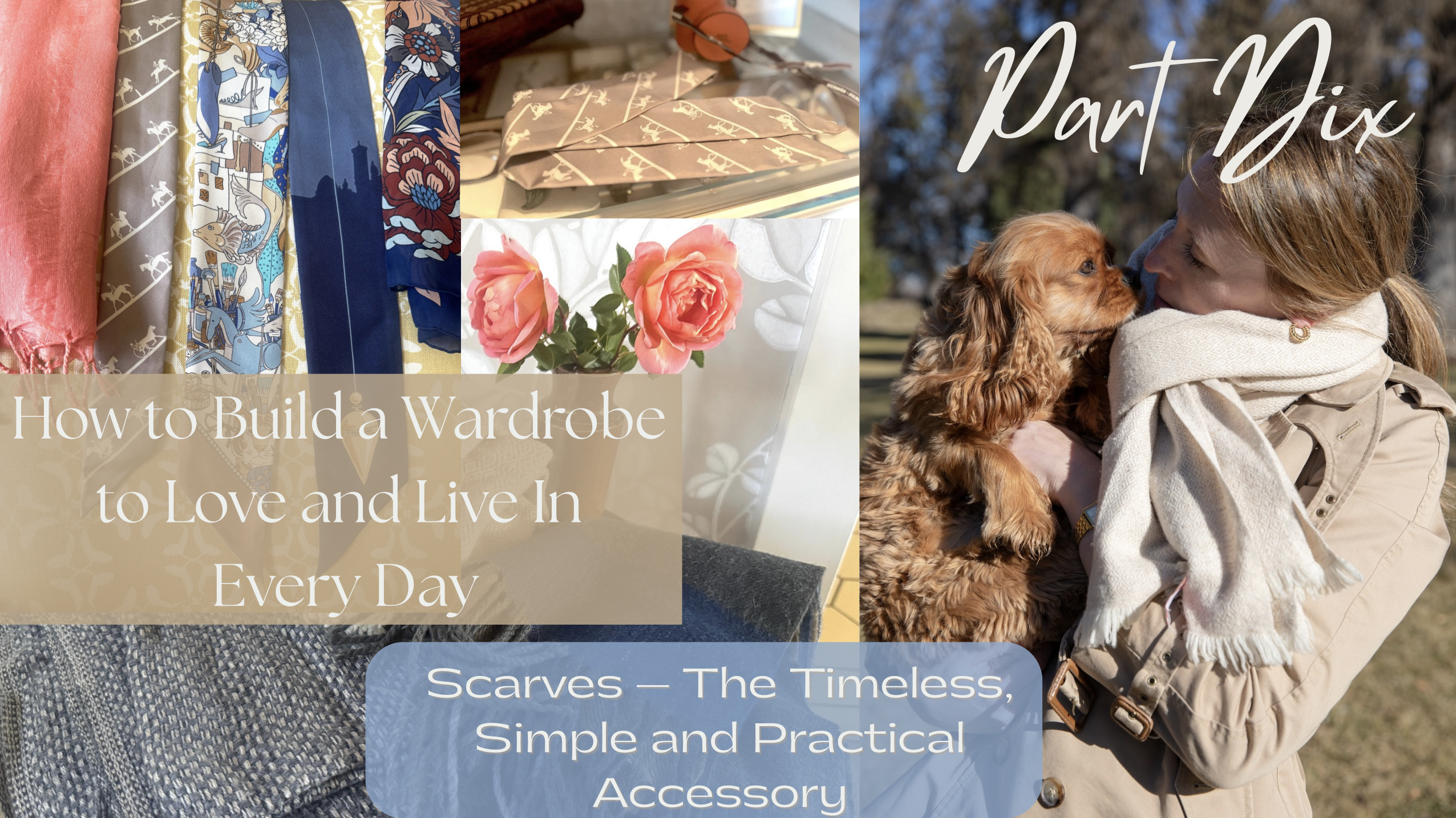
Part Dix: Types of scarves and how to style
In French, écharpe means ‘scarf’, and a scarf’s primary purpose is to keep us warm when we wear it; however, there are a few different types of écharpes, such as le foulard, which is a small scarf (neckerchief) that is, hence the English term, worn around the neck and typically made of silk or a silk blend. But let’s take a look at the terms we might most often come across while shopping, so we know what to search for once we know what we want and what would work best for our style and lifestyle.
Types of scarves:
- Rectangular (oblong/long) scarf
- One of the most common scarves, and the simplest to style. Available in all different fabrics (talked about below), as well as varying lengths and widths.
- Large square
- This style is often what we think of when we think of the classic Hermés scarves. The flagship carré size 90cm square (35in) was first introduced by the brand in 1937.
- Worn draped over the shoulders or loosely around the neck, it is also used as décor, framed and hung on walls.
- Small square
- The smaller square style of the two, 70 cm square (27in), often the scarf that is seen tied around the neck in artistic knots.
- Pocket squares or mini scarf
- 45 cm squared (17in), this scarf too will be worn around the neck tied creatively as it will be rolled to give the impression of a narrower scarf. To solve the puzzle and remove the difficulty, many designer brands finally created the scarf we come to below, so that we could create the same look without the fuss.
- Ribbon or skinny scarf (the Hermès ‘Twilly’ or Dior’s ‘Mitzah’)
- Introduced in 2003, Hermès brought shoppers the narrow (5cm x 86 cm) scarf (there is also a ‘long’ version of the Twilly that is 104 cm).
- Dior realized this was a worthwhile endeavor and in 2015 introduced the Mitzah scarf. (named after Mitzah Bricard, Christian Dior’s close friend, collaborator, and iconic 1940s style muse who was famous for wearing a leopard-print scarf tied around her wrist). The Mitzah is slightly wider and longer in its traditional size – 6cm x 105cm)
- Ferragamo also has ribbon scarves, which they call mini bandeau (you will see one below in my photos). The size is 5 1/2 cm x 139 cm.
- Many other brands offer this style for the simple reason that they simplify the scarf tying process and provide the same style and/or look.
- Stole
- A large rectangular scarf, many may use it as a small blanket. Made of wool or cashmere most often. Not to be confused with a shawl, which, while large, is a triangular shape.
- Snood
- a more modern option that resembles a continuous, tube-shaped scarf or cowl. It can be slipped over the neck for warmth or pulled up over the head like a hood.
- Pashmina
- technically still a stole or a shawl, made with a particular type of cashmere from the Kashmir region (India/China/Pakistan), fine wool of the pashmina goat.
Fabrics and when frequently worn:
- Wool, cashmere, pashmina (winter and autumn)
- Linen (summer and spring)
- Silk twill (often found in the ribbon, skinny or foulard scarves)
- What determines if silk is twill is the weave pattern which gives it more substance and is less delicate. It also holds its shape better and can better be put into a knot. “Silk twill specifically uses a parallel diagonal (or slanted) rib structure.”
- Silk (Regular silk can be woven in many ways—such as plain weave, satin, or chiffon)
- square scarves as well as some rectangular scarves
- Cotton – a great option for summer. It won’t necessarily keep you cool as linen will, but it protect you from a slight nip in the air without being heavy or cumbersome.
- Blends – satins (often made of silk or polyester blends)
How to Style
Below, I will share with you my favorite ways of styling both silk scarves (the ribbon and skinny) and wool scarves and stoles. But below is a list of ideas, concluding with a helpful resource to save for oodles of videos to watch from a trusted scarf source:
- French / Parisian Knot (European Loop): This is the most classic and easiest – Fold a rectangular scarf in half, drape it around your neck, and pull both loose ends through the folded loop.
- Classic loop: Drape the scarf around your neck, with one end longer than the other. Take the long end and wrap it around your neck once.
- Once-Around: Drape the scarf so one end is longer, wrap that long end once around your neck, and let both ends fall front or back
- Ascot Knot: Drape the scarf around your neck so that both ends hang evenly. Then, cross one end over the other to form an “X.” Bring the top end up and through the loop around your neck. The ends can then hang naturally or you can tuck them into your jacket, blazer or coat.
- Classic square knot: Take a triangular or folded scarf, bring the ends forward, cross the right side over the left and under, then cross the left over the right and under to lock a flat, secure knot.
- Side Knot/Shoulder Bow: using a ribbon/skinny scarf, either wrap around your neck once or twice, and then double knot (cross the right side over the left and under, then cross the left over the right and under to lock a flat, secure knot.). I will show many options of this below.
- Hermès has a wonderful video series on their website for all the different scarves they offer and how to style them. Check them out here.
The Scarf I Recently Added to My Wardrobe (and the ones I have and love
Having shared already that I don’t want to fuss over my scarf, when I found ribbon or skinny scarves, I did a happy dance. I have two now, one purchased back in 2023 and the other this autumn. And the ease of wearing them, tying them, styling them was the best gift to myself.
The most recent addition, and what sealed my adoration, was found on The Real Real (there are MANY of this style on the online consignment sites – Vestiaire Collective is a great place too). The Hermès Twilly Scarf (seen just below).

Looking for a neutral scarf that would pair with many different tops and dresses, I found this equestrian (beige/soft blush) scarf for $186, regularly $328. I was thrilled. And while the product page said there was slight discoloration, there is nothing discernible to the eye. All the more encouragement to buy consignment, save money and pick from a range of collections that are no longer available at the original source.
These very narrow, short scarves were introduced, as shared above, only just recently in 2003. Measuring just 5cm x 86 cm, the narrowness helps to create a clean line on the neck, and just barely can it wrap around twice (see below), but that is all you need if you are looking for a streamlined effect. I double knot mine, and that’s it.
Each Twilly scarf comes in the small orange Hermès cylinder as seen above which also helps to give it a safe place for storage and packing.
The key component that makes these scarves a better choice than a small square silk scarf is that they are made of silk twill which means they will hold the knot more securely, hold their shape and not ‘slip’ out of place on your neck as I found often would happen when I attempted the fancy knots, twists and rolls with the silk square scarves. Needless to say, the type of weave makes all the difference, and thus why they named it ‘Twilly’.

Other scarves I have and love
Below you will see in the middle my other ribbon scarf. Not made of twill, but of classic silk, it is a bit more slippery, but the length is lovely. Ferragamo’s mini bandeau scarves (as they are named on their site), are a bit wider and so there may be a bit more fabric on the neck which may be uncomfortable or scrunch up a bit. For that reason, next time, I would purchase a long Twilly or a Dior Mitzah for the smaller width and making sure it is made of twill. However, I have worn and continue to wear this scarf and love it. See four ways to style it below.


Scarves seen above: the pink scarf is a silk-blend, long and rectangular, that I picked up in New Orleans more than eight years ago. I often wear this in spring and summer as it is lightweight, but it can still make a statement with a neutral dress. On top of that scarf is a striped linen scarf I picked up at a market in Paris for 20 euros. I wear this regularly in early spring and autumn. It gives me just enough warmth, but not too much. The navy scarf is a lightweight silk chiffon that is worn with my trench coats to add color or with my blazers. I will often just let it rest around my neck. The front scarf is Ferragamo’s ribbon/skinny scarf (seen below).


My wool scarves have been collected over the years, and I return to them again and again. Dry-cleaned each year after winter, they remain in good, soft condition and pair with all of the outfits I tend to wear, being that they are fairly neutral.
Seen below: (left) a goat’s hair from England – This is a stole and oh my goodness is it soft. I picked this up in Barnard Castle back in 2023, up in County Durham. In the middle is a cashmere scarf that Sharon Santoni included in one of her My French Country Home boxes. I have had this for over five years, and it continues to be a favorite stole. On the right is a shorter, classic tartan wool scarf that I picked up in England. A man’s scarf, but that doesn’t matter if it is what you want, and I love it. I have named this scarf Linus and tend to wear it when I go walking as it isn’t as bulky (not as long) but still very warm on the neck.

The two ways I wear my wool scarves/stoles:
French / Parisian Knot (European Loop): A simple double-up, wrap around, and pull the ends through the loop. That’s it! Seen below:

The second option: Begin with the Classic Loop – pull both sides behind you so you have the center of the scarf at the front of your neck. Then pull either side around the back of your neck (the ends will appear on the opposite side of one another (first pic on the left). Then single knot in the front. Keeping it simple.


And with all of the scarves, you can always just loop it around the back of your neck and let either side hang down (as seen with the Ferragamo ribbon/skinny scarf). I like to do this when I am wearing a coat that is either open or buttoned up if it isn’t terribly cold or I just want to add a pop of color, but don’t need the knot at the neck.
Let’s Go Shopping for Scarves!
Shopping for scarves in many ways is like a treasure hunt. Partly because they are timeless and don’t have a ‘size’ therefore anyone can wear them, they are items that seem to pop up everywhere. Which means that we can find them almost anywhere. Even the brands we love and prefer can be found on consignment sites online, brocante shopping, second-hand shopping- you name it. So while I highly recommend scouring consignment sites as I did above, or popping into local boutiques to find treasures that are not online, below are brands to look for, trust, and purchase.
This list is not extensive. The key is to buy what you love, what will last, and what you can style as you prefer. Look at the material (remembering that twill silk is different than other silks and is preferred for precise knot tying), how does it feel on your skin? How will you be able to care for it (wash, dry-clean, etc.), and do you really want fringes? Details matter as they do with the clothing we wear, and when we purchase well, we will have a go-to accessory to wear for years, even decades to come.
Luxury:
- Hermès
- Dior
- Aspinal of London
- Gucci
- Acne
- Burberry
- Loro Piana
- Toteme
- Ferragamo
- Eric Bompard (the place for classic, multi-colored options of cashmere scarves – no logo is present to offer a timeless, effortless, quiet luxury look)
- Miu Miu
Miu Miu’s printed twill scarf (ribbon style), three colors

Mid-Luxury:
Longchamp’s A Tout Allure silk scarf, coffee (more color ways), 90cm


Strathberry Silk Skinny Scarf, many colors, $110


Budget, yet worthwhile:

The Series Continues! And A Task for You!
The series, How to Build a Wardrobe to Love and Live In Every Day, continues with Part Onze/Eleven next month on Tuesday, November 10th, when we will talk all about handbags.
But between now and then,
Your task/homework assignment for your Lifetime Wardrobe project:
- Determine what type of scarves you would like to wear
- When would you wear the scarves? What fabric would be best?
- Seasonally
- Outdoors
- Indoors
- What colors work well with your wardrobe and your skin and hair color?
- How simple or complex do you want scarf tying to be?
- Then start to identify the brands that sell the scarves you love.
- Save your favorite scarves to KarmaNow if working within your budget, and purchase when you are able.
SIMILAR POSTS YOU MIGHT ENJOY


Good scarves last forever. And when traveling, they weigh nothing and don’t break!
Good point Jasmina! A wonderful item to find while traveling and bring home. 🙂