Become a Member for as little as the price of a croissant and enjoy unlimited reading of TSLL blog. Add the cost of your favorite cuppa and enjoy ad-free reading site-wide, including all exclusive content.
Belts.
They appear so simple, so small in proportion to many of the other items in our wardrobe, but they have such a powerfully, positive and polished impact when chosen correctly. Whether we are looking for a professional look or a casual, foot-loose and fancy free look, a belt adds a signature that is our own no matter how subtle or attention-grabbing it might be.
As we have moved through our year-long wardrobe project, I have shared that we are working from a list compiled of items that will ‘fill the gaps’ in our current wardrobe, finish the wardrobe that speaks most honestly to who we are, how we live and who we want to project to the world.
As we step into the second half of our project, I want to introduce you to an additional approach to keep in mind when considering the 12-15 items you are shopping for (be sure to read Part Une to see the detailed list of how to get started and make your shopping list for the year).
So often we shop for clothing and for accessories with the mindset of ‘what we need to add’, but as I read when trying to better understand how French women create their own wardrobe which often consists of fewer items, yet they always seems to leave them looking effortlessly chic, they approach it differently. They look for ‘what will connect’ to other pieces in their wardrobe. The requirement of any item being ‘added’ is that it must connect to multiple items, completing looks and not just one.
When we shop with this shift in mindset, we will shop more wisely, need to shop less often and be willing to invest in the items we do purchase even though not all of them need to be investments. The belt is the perfect example of this, but so too is every other item we have focused on and will focus on throughout this series. While there are gorgeous, unique belts out there, we must find belts (I regularly use two, and sometimes a third) that finish the outfits we already love to wear but are just missing that certain something, or will complement the wardrobe we are building through this project.
Because these items are for our everyday wardrobe, the belts and each clothing item is versatile by design, and this immediately narrows down the choices. As you will see below in the belts I have in my wardrobe (old and new), they are pretty ‘basic’ looking, but they are exactly what finishes my wardrobe and with the two new ‘connecting’ belts I purchased in June for this project, I know they will last a lifetime. No more belt shopping for me for a very, very long time. And I prefer it that way.
But first! What did we talk about in the last part of this series – Part Six? Have a look below at your homework assignment.
Part Six: The Benefits of a 12-month Approach

Part Six Wardrobe Task

Take a look at your list of items you still would like to purchase. Rearrange the order of purchasing as needed, and remind yourself not to rush. If you need to take a month or two off, permit yourself to do so, but then do yourself a favor you will appreciate down the road and for many years to come: be sure to return and complete this project. It is an investment in yourself, and you are the best person to know what you need to look and feel your best, so long as you have the tools to find them. I hope the book shared on the Lifetime Wardrobe homepage and this series are helping you do that, and I look forward to diving back into shopping well for items that you will love and that will last next month.
Now, let’s learn how to shop for the belts we need and that we will want to wear and be able to wear for decades to come. Part Sept – it’s everything you’ve ever wanted to know about belt shopping.
Part Sept: Belts — How to Find the Essential Finishing Touch for Timeless Style
What a belt adds to an outfit
Each outfit we wear will require a belt to play its role differently depending upon the outfit’s needs. Below are the primary reasons to consider wearing a belt with just about every outfit you may have, or at the very least, consider it as a tool to enhance your look.
- Finishes a look, creating an intentional, aesthetically pleasing-to-the-eye ‘seam’ between two separates (top and bottom).
- Functionality, holding trousers, jeans, a skirt or a blazer closed or at the place on the hip or waist that we prefer.
- Creates a desired silhouette. For example, cinching a shift dress gives the body curves where the dress was giving none.
- Draws the eye to desired focal points of the body – waist – which can distract from other parts of the body.
- Differentiating texture from the fabrics which adds depth to an outfit even if in the same color.
- The chosen accessory that ‘shines’ or reveals our signature style or states we don’t need any other jewelry.
How to find the correct size for you
- The perfect size: the middle hole of the three or five holes provided fits best with your waist (or hip) size. This ensures that there is proportionally enough of the belt’s tail to extend through one belt loop (not too short), or too much so that the tail hangs or needs to be continued to the second loop.
- HOWEVER! If you need to size your belt to better fit you (make it smaller), I will talk more about how to do this below.
- Many belts offer sizes in CM (centimeters), and that measurement is to the center of the belt buckle, not the full length of the belt. In other words, it indicates your waist circumference. A traditional sizing method will put the middle hole of the belt at that measurement with the proportional tail.
- To determine your size, grab a fabric or ribbon tape measure and stand up straight, running the tape measure around your waist where you would like your belt to fit. If you would be wearing bulky clothing underneath the belt, wear that clothing item (or something similar) and measure on top of it.
- Even if the belt doesn’t have any holes at all, which you will see one of the belts I have does not have holes, the size (length) is determined by the circumference of the waist to the middle of the buckle, not the full length of the belt. The designer will add enough length for the belt to look proportional when it is cinched.
- Each brand has its own size guide, so once you have your waist measurements, consult its size guide to ensure you choose the size that suits your measurements.
How to determine the best belt width for your outfits
When deciding what width of belt to wear with your outfit, observe the following about the clothing items:
- The length of your hem – short, knee-length, midi, ankle, etc.
- The general rule of thumb is that the longer the hem, the thicker the width. For example, with a pair of shorts that hit mid-thigh, a thin belt would be better as opposed to a pair of trousers that skim the top of your foot which would work well with a thicker belt of 1 1/2″ or 2″.
- Wide belts that cinch the waist can work well with any length as the purpose is to accentuate your waist.
- However! All style rules are meant to be broken based on our signature style and what looks good to our eye. A beautiful mid- or longer-hemmed dress may look better with a thin belt to complement the delicacy of the dress and how it is made. The Princess of Wales has demonstrated this more than a few times.
- Are there belt loops already part of your trousers, jeans, etc.?
- If there are belt loops – jeans, trousers, for example – be sure to find a belt that fits the width comfortably without being too narrow, as you want to prevent it from moving around.
- Is the occasion/outfit formal or casual?
- Generally, thin belts complement more formal outfits while thicker belts work best with casual attire – jeans, khakis, linen, etc.
Types of belt styles to consider
- classic symmetrical buckle belt – the most common belt sold and worn due to its versatility. These belts may have an asymmetrical buckle, but most will have the same design on either side of the center of the waist when fastened. As shared above, they can be worn with casual clothing, often are, but can also be worn in more formal occasions depending on the outfit, hem-length and needs of the outfit (cinching a blazer around the waist for example).
- skinny/thin belt – as shared above, these belts tend to be worn in more formal or professional occasions. Typically .4 – 1.0 inch in width (10-25 mm)
- a knot belt – this belt will often have the tail intentionally longer and looped straight down after cinching or buckling at the mid-waist point.
- corset belt – just as a traditional corset would do, these are large in width and cover move of the waist to pull it in, drawing the eye to the waist.
- o-ring belt – functioning like a ‘D-ring’ would as you are able to adjust with ease the waist, pulling tighter for a snug hold on the waist or loosening to wrap around more bulky clothing. They are available in all fabrics and textiles.
- western belt – determined by the style of belt buckle, the buckle will be asymmetrical and have a western style design with tooled leather, conchos or inlays.
- studded belt – think of Carrie Bradshaw’s black studded belt that appeared frequently in the Sex and the City series. Fondly named ‘Roger’, SJP still has it in her closet. This style of belt can be wide or thin and come in all sorts of colors and designs of studs and finishing metal details.
- reversible belts – just as it sounds, Ferragamo has become well known for their reversible belts which is a great bargain as you get two luxury belts in one if you like both colors on either side.
- wide belt – the belt to have for cinching the waist without wearing a corset belt. These can be 2″ – 4″, it really varies, and are perfect for wearing with a dress that you want to give your own style to, cinching a blazer or a coat or a high-waisted pair of trousers or skirt.
- braided belts – just as it sounds, these belts are more casual, playful and can be in any width, color or design. They are often adjustable, similar to the O-belt shared above, due to their braided design.
There are a few other belt designs, such as the chain belt or hip belt, but for our purposes in this series, we’re looking at belts for everyday style, worn frequently and not with special occasion outfits, although many of the belts shared above, being versatile as they are, absolutely could be worn to finish a special occasion outfit.
Let’s talk materials, colors, and designs for longevity and versatility
“A well-chosen belt does more than complete an outfit — it’s an investment. The material quality and buckle design determine durability.” —Danilos Fine Leather
For a belt that will be with you for your lifetime and still look good decades later, paying attention to the materials is essential. As someone who did have quite a few belts during my 20s for the variety of nice outfits I wore for teaching, I did not pay a lot for any of them because I couldn’t afford to. They were made of synthetic materials and didn’t last long, but they worked for what I needed at the time, and that is where we shop for what we need, why we need it and in our budget.
Today’s post is for your lifetime wardrobe. When your budget allows, the belts that will close the gaps, finish the outfits and look good for decades, go ahead and purchase them. Have confidence that the purchase is worth the price because you’ve done the homework of your style.
If you purchase leather, it is the best option for longevity. Faux leather is viable as well, but if you wear the belt regularly, the quality will likely only last for 3-5 years due to its composition. I will share that one of the belts you will see below is a belt I have had for almost 20 years. It is leather, I wear it all of the time (as you will notice due to the discoloration of the buckle) and I love it. I don’t want to buy belts regularly or again, and so I was grateful that this one lasted because it suited my style well and is very versatile.
Belt Material:
- Leather: shop for full-grain leather which is the highest quality of leather available. There will be no peeling or splitting which will happen in inferior types of leather.
- There are three grades of leather. Let’s look at them so you know what to look for on the label and what they each mean:
- BEST: full-grain leather – it is strong, resists stretching (you will notice my belt that I mentioned above, did stretch, so it was not made of full-grain leather), and will develop a rich patina with age that is beautiful.
- Will be more malleable, but still hold its shape.
- SECOND: top-grain leather – most common and popular with mid-priced belts. “The very top, imperfect layer is gently sanded or buffed away. It is smoother and more uniform than full-grain, but slightly less durable.”
- Try to avoid a lifetime purchase, a misleading and lesser quality: genuine leather – “While it is technically real leather, it is typically made from the lower-quality split layers of the hide, making it prone to stretching, cracking, and peeling.”
- BEST: full-grain leather – it is strong, resists stretching (you will notice my belt that I mentioned above, did stretch, so it was not made of full-grain leather), and will develop a rich patina with age that is beautiful.
- Synthetic or Vegan:
- More affordable and versatile
- Available in a wide range of colors and textures
- Less durable than leather
- Canvas or Fabric:
- Lightweight and comfortable
- Perfect for warm climates and relaxed outfits
- Can last a long time if kept clean.
- Care for fabric as you would a piece of clothing.
- There are three grades of leather. Let’s look at them so you know what to look for on the label and what they each mean:
Buckle Material:
- Solid brass
- versus ‘a brass finish’, is it resistant to corrison. Polish as you would any brass detail.
- over time, can show a beautiful patina.
- solid brass is the most preferred for longevity of retaining both its design and color.
- Stainless steel
- known for its durability and strength
- so long as it is solid stainless steel and not finished with anything (see below), it will be a belt buckle that will last a long time.
- (not recommended) Nickel-plated
- Usually a steel or zinc buckle coated with a thin layer of nickel. This provides a bright, silver-like shine and rust resistance. However, with time, that nickel layer will “chip or wear away, exposing the base metal beneath and potentially ruining the finish. Additionally, nickel is a very common skin allergen.”
It is the two materials that make up the belt – the strap and buckle – that increase the price when well made and with quality products. It can be alarming to see how much more a high quality belt is compared to what we see, say at J.Crew, but remember to look at the materials and that will tell the story of what you are actually getting and how long that belt will perform and look as it did on day one.
Details to remember to ensure a tailored look and how to save money if possible
- Be sure to shop in the men’s section as well. Once you know the width you are looking for and the style, if you find what you are looking for and it happens to be in the men’s section, who cares if it’s not designed for women? It’s what you want, and as I learned, it is often cheaper. The key is to buy the right size as you will likely have to size way down. But even if they have sizes that are too big, you can always . . .
- Have your belt tailored. Yep! One of the belts I will share with you that I purchased below is from the men’s section and it is far too big, but I saved a pretty penny as it went on sale and was exactly what I wanted. However, it is an investment belt, so it will be going to a tailor in town who will finish it to my size and make it look just as it would have from the designer – trimmed in thread and with new holes.
- Buy a leather hole punch. For less than $20 (this one is similar to the one I have), you can add your own holes in your belt, and if I didn’t need to shorten my belt, I would have done this. Using a knife is fine, but it won’t look polished, and if this is an investment belt, you want it to be done right. For a low price of $12 for the hole punch, you can provide this nice finish.
- Quality materials make all the difference in ensuring your belt lasts and looks as good as it did on the first day, as it will twenty years from now. Yes, that is absolutely possible.
Street Style posts/articles to explore for sartorial inspiration:
The Belts I Added to My Wardrobe During this Project
The two new belts I added

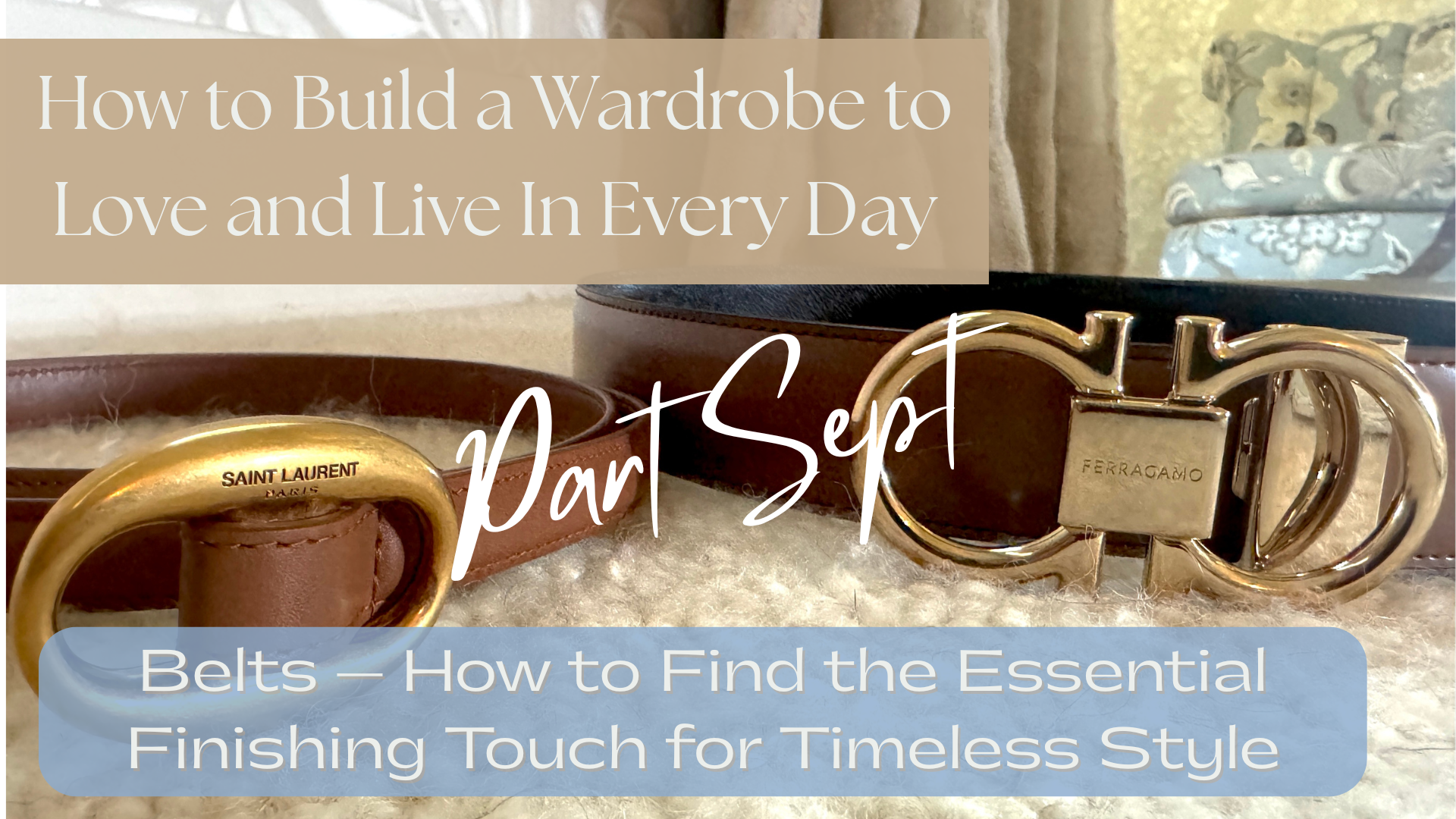
I shared in July’s A Cuppa Moments (you will see me wearing the Saint Laurent belt) that both of these belts have been saved on my KarmaNow app so that if they went on sale, I would be alerted. It took five months, but the Ferragamo belt did go on sale last month with a significant reduction. The Saint Laurent belt never went on sale… anywhere, especially not on the home site of Saint Laurent. This was informative as I knew that a discount was not to be had.
However, and most importantly, I am thrilled with the quality of both belts. The belt straps and buckles are supple, yet substantive and the buckles are not light in the least. They are solid brass (YSL) or solid gold-tone metal (Ferragamo). The stitching around the edges is straight with no frays, and the colors are as they appeared.
I ended up buying Ferragamo’s belt (which is from their men’s collection and will be taken to the tailor next month) directly from Ferragamo, and the Saint Laurent thin belt (brick color) from Bloomingdale’s. Bloomingdale’s required that I sign for my package to ensure I received it.
- Ferragamo’s Reversible and Adjustable Gancini belt in dark brown. While currently no longer on sale, I did save 40%, paying only $355 (regularly $630). Ever so grateful to have the KarmaNow app.
- The buckle is sturdy and fits securely into the belt holes which hold it level to the eye.
- UPDATE 8/21/26: The buckle is also easily removable with a snap so you can size the belt easily, trimming off the excess leather and not have to restitch or create more holes. More on what I needed below:
- As it is a men’s belt, it is waaaaay too big, but I found a trusted tailor in Bend (evidenced by her long waiting list – late August), and she regularly customizes leather belts (stitching, holes and all), so I look forward to taking it to her and having it cut and sized to fit me!
- UPDATE 8/21/26: When I took my belt to her, she showed me this option that Ferragamo belts offer – the belt buckles are easily detachable (I neglected to share with her the brand when I scheduled.) For only $10, she sliced off the extra leather, and gave the belt right back to me then and there!
- If the brand of belt you are purchasing provides this ability, purchase a longer belt than you need so you can customize it to exactly the length that fits you best when it arrives.
- While it says it is reversible, I will be honest and say that it will be nice to know I have a black belt if I want it, the texture is different on the other side and I likely never will.
- The buckle is sturdy and fits securely into the belt holes which hold it level to the eye.
- Saint Laurent’s oval buckle thin belt in brick (aka brown). Other colors and types of material are available. Shop all of them directly at Saint Laurent here and here (the black belt – silver or gold buckle is less than the brown).
- Available at the following:
- You’ll notice that this belt has no holes. And to my eye aesthetically, I loved it. Rest assured, it stays put where you place it and doesn’t slip as I have worn the belt a few times already having received it last month.
- I ordered the 90cm (36″).


What belts I have, love and have worn for years:

Above, you will notice that I stick to browns. I used to have a few black belts, but I don’t wear black anymore, so that has simplified my choices for belts. The two belts on the right are worn frequently. The wide belt is from Sézane and was purchased about five years ago (notice how the leather is not one piece – this is also a sign of less quality. The one on the far-left is my nearly 20-year-old belt, and I don’t remember where I purchased it, possibly J.Crew. I wear it regularly with my jeans to cinch blazers and even some dresses that need a waist. It wasn’t expensive, but as you notice in both of these two belts, the leather isn’t top quality. However, I will continue wearing them both for many years to come.
Each buckle of my two belts on the right is solid brass, from what I can remember and observe.


Where to Find Belts You Will Love for Years
Below is a list of brands to consider when it comes to the trusted quality of belts that will last. I included luxury and mid-luxury but only a few budget-friendly because nearly every brand carries some sort of belt if you need one for a short duration or particular outfit and don’t want to break the bank.
And now that you have all the knowledge you need to ensure you are buying a quality belt, shopping consignment is a great approach for saving money and being sustainable. Be sure to explore Vestaire Collective and TheRealReal for oodles of consigned items.
Luxury
- Saint Laurent
- Hermès
- Gucci
- Bottega Veneta
- Louis Vuitton
- Loewe
- Khaite
Mid-Luxury
- Altuzarra
- Love their classic A belt (three colors) and thin A belt

Budget-friendly, yet worthwhile for dependability
The Series Continues! And A Task for You!
The series, How to Build a Wardrobe to Love and Live In Every Day, continues with Part Eight next month on Tuesday, August 11th, when we will talk all about blazers.
Between now and then, look at the wardrobe you have that you already love and the pieces you will be adding with this year-long project. What types of belts would connect and elevate/finish each look? Which type of belts would be worn and preferred most often? Narrow your belt selection down to 1-3 belts, and then go shopping for them. Save them to KarmaNow, and if the price doesn’t fit your budget right now, or you want to see if you can save money, keep an eye on it for a few months. This will also give you time to really consider which type of belts you need and want to wear.
SIMILAR POSTS YOU MIGHT ENJOY


This past weekend I purchased three belts from J Crew and I look forward to their arrival. I was so eager to add them to my wardrobe when you discussed them in A Cuppa Moments. They really do finish a look and I can’t wait to add this zing to my outfits. I appreciate the attention to detail in this post! Love your choices of Saint Lauren and Ferragamo. The buckles pop!
Tickled you found what you love Mary! Thank you for sharing. 🙂
Belts are so important to finish the look- I have learned they can really elevate your look. I would add Nili Lotan to your list as I have 2 of her belts and they are great quality
Arati,
Thank you for sharing your recommendation and experience with Nili Lotan. I love her denim and carefully considered everyday designs. Will definitely keep her on the list of worthwhile belt shopping brands. 🙂
Bonjour,
What are your thoughts on ‘ below the belt’ , I remember
you mentioning it.
I’m thinking of getting one from Nordstrom- not on sale , but looks very classy .
– Kate
Great question Kate 🙂
The key is proportions so imagine the outfits, separates you would be wearing it with. The width of the belt should be in balance with the blousiness of the pants and top, and as it will bring attention to itself, make sure it sits where you want to bring attention. Beyond that, if you love it, then buy it! You know best what you feel comfortable wearing and will reach for again and again. 🙂 Sounds like you found a great belt!
Thank you …
Onto my wishlist ( Nordstrom)
Xx