Become a Member for as little as the price of a croissant and enjoy unlimited reading of TSLL blog. Add the cost of your favorite cuppa and enjoy ad-free reading site-wide, including all exclusive content.
Sideways. Often a term associated with glancing, looking, or moving from side to side, or figuratively referring to something not working out as we’d hoped. However, today, with the help of a new book that brought it to my attention, I want us to reframe this term as we discover how intentionally remembering to live sideways while we strive forward toward our goals, or set sail in the direction of our intentions, is a recipe for living a life of depth, quality, and richness.
In a world that may feel as though it is perpetually pushing us forward, or pulling us forward as it sometimes seems, if we don’t cultivate a life that nourishes us, we can easily be swept along with the current, focused only on outcomes of productivity, results or finished work or accolades for that work. How we engage with our journey along the way will then become less important, and we have forgotten that living now is all that we have guaranteed.
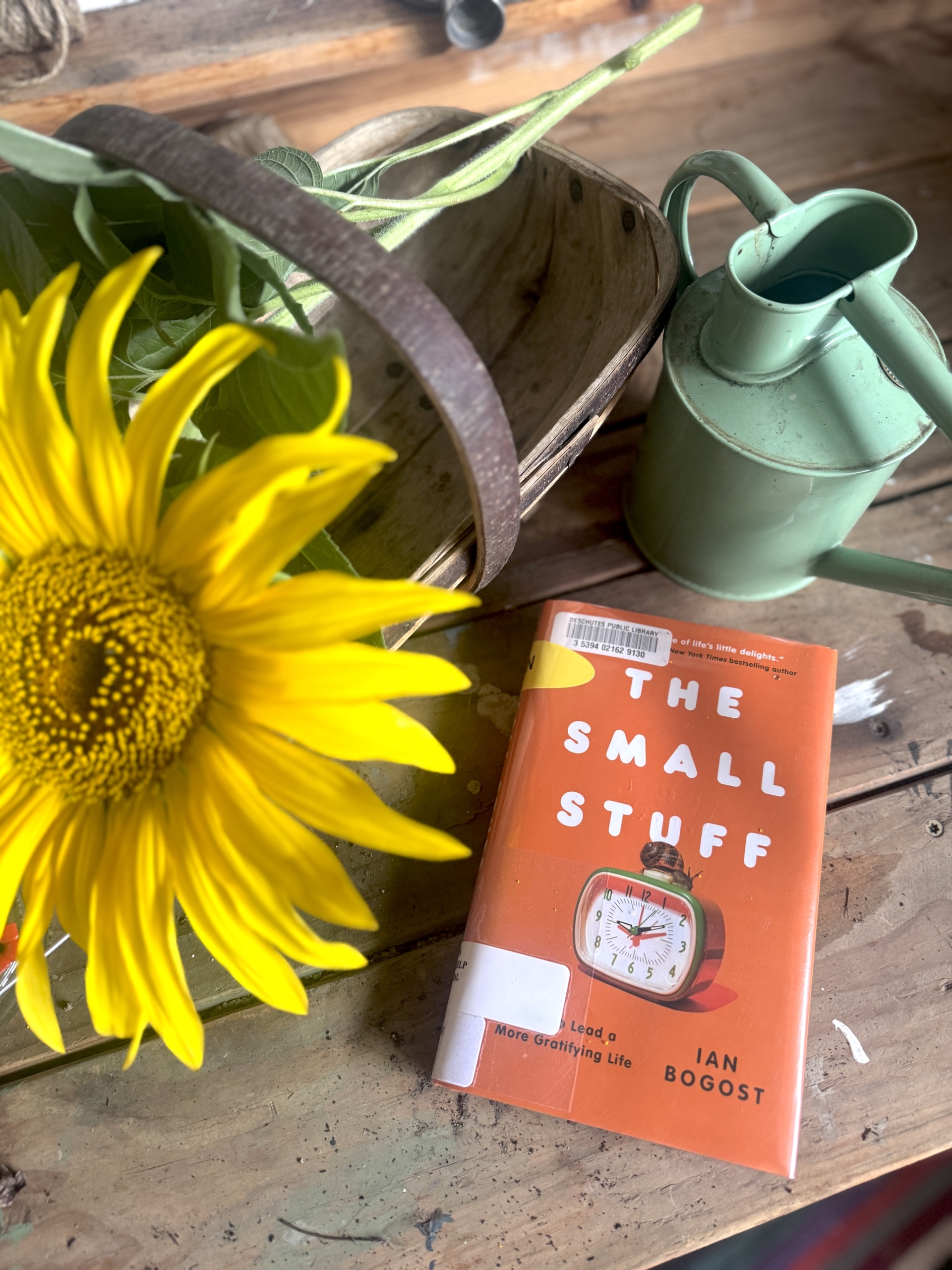
Contributing writer to The Atlantic and professor at Washington University in St. Louis, Ian Bogost speaks the language of living simply luxuriously in his new book The Small Stuff as he reminds readers to focus on the seemingly everyday, mundane minutiae of life, and drink it up – notice it, appreciate it, celebrate it.
There are oodles of ways in which we can do this on a regular basis. The necessary component to each of the approaches is consciously being mindful of the now, of where we find ourselves and all that surrounds us. In episode #163, we broke down the ‘how’ of doing this.

Which brings us to remembering to live sideways.
We each have the responsibilities of our daily life – our job, our home tasks, family commitments, etc. That is a living forward in many ways. Tending to what needs to be done in order to make progress and enable others (or a company) to progress positively. By remembering to also live sideways, we choose a hobby or avocation that is not seemingly necessary to this progress, but indirectly elevates the quality of our ability to live, and deeply enjoy our life. In other words, it deepens our contentment, which is our ease of being and interacting each and every day.
This concept of sideways actually has a proper term, and Bogost introduces readers to it who may not have a math background (I don’t). The term is orthogonality.
“The idea is called orthogonality, it’s just a fancy name for a perpendicular—such as a line intersecting another at a ninety-degree angle. Applied to more concrete domains than geometry, one thing is orthogonal to something else when it contains distinct elements that complement but do not interfere with those of the other.” —Ian Bogost
That last phrase, “contains distinct elements that complement but do not interfere with those of the other.” This definition means that each of us will find ways of living sideways that will be unique to what we already are doing in our ‘forward living’ part of life.
And here’s the other definition of what makes something sideways. It need not be something in which an outcome is ever produced that would be typical. For example, learning how to be a ceramicist. If throwing clay on a wheel is our sideways choice, we don’t ever have to create something deemed beautiful or even something that can hold water or be used. The outcome isn’t the point when it is our ‘sideways’ choice. The point, Bogost points out, is for the sideways activity to be gratifying, with no need to be satisfying.
“Orthogonality—the art of living your life sideways—is not meant to create hard rules or unbreakable guidelines. As you search for gratifying complements in your life, focus less on the output of the practices you undertake than on the moment-to-moment experience of doing them. That’s where the orthogonality lives, in the sensory encounters, not in the work or leisure itself.” —Ian Bogost
How something complements our life is that it brings us deep pleasure to partake in it. It holds our full attention. It tickles our curiosity. We do it for free. This is an enriching activity where our mind relaxes from thinking about anything outside what we choose to do in our sideways pastime. And that complements the rest of our life because we return refreshed, renewed, rested (ironically, even if we were physically active), and happier because what we were doing reduced the stress and likely released endorphins. Something we talked about in episode #433 when we talked about how we can improve the health of our brain.
So what will be your sideways activities? Choose ones that engage your senses. For me it is sight, smell and sound. Because I spend so much time on the computer, and even though it is a creative outlet for sure, when I step out into Mother Nature, into my garden, I have the tactile elements at my fingertips that are not present when I am working with my computer.
“Finding an orthogonal hobby requires focusing not on outcomes different from those of your normal life, but on the sensory encounters you might not normally encounter while leading that life.”
It is important to note that, if you too are choosing an outdoor activity as your orthogonal/sideways hobby, it’s “not because nature cures screen-based mind rot, but because it invites different opportunities for sensory connection.” Conversely, if you are a landscaper in your work life who designs gardens for clients, you may choose an avocation that involves working with fabrics or upholstery for a different feel of textures as opposed to living plants. The important component in being an orthogonal hobby is that it is not the same as what you do in your work or have-tos, but it does complement in that it fuels you and is something that you enjoy spending time doing.
Let’s go back to the difference between something that is gratifying versus something that is satisfying. Bogost points out that “gratification is the sensory enchantment of everyday life” while “satisfaction is the pride in accomplishment.” Note the difference: gratification focuses in on the moment, savoring what we are experiencing – the sights, the sounds, the scents, the textures, and flavors; whereas satisfaction is about outcome, the end point.
All sideways living asks of us is to tune in to our senses right now, in the moment. To be mindful. Paying attention fully. And with the knowledge of ourselves, we choose to do something intentionally that we love for the sake of just doing it. Bogost shares the example of a fellow professor who teaches English and how his sideways activity of choice is fly fishing. He never brings home any fish that he catches, but instead immediately releases it back into the water. This example demonstrates how being gratitfied in what we are doing is what it is all about, not about the outcome (catching a fish) which would make it a satisfying experience. The gratification comes from being out in the elements of Mother Nature, hearing the stream of the creek or river, observing the fish and other wildlife, taking enjoyment in the rhythm of throwing the line into the water, perhaps, as is the case with the mentioned professor, making your own flies, an art in and of itself and seeing which the fish respond to.
How this elevates (or deepens) the quality of our life
A helpful analogy Bogost brings up is the difference in the games of checkers and chess. The pieces themselves and how they can move. First, checkers has fewer variations of pieces and fewer options for movement based on reaching various places on the board successfully. Chess, on the other hand, gives players ample movement and strategic options through a variety of pieces with different mobility, freedom, and direction. “The relationships between the different chess pieces are orthogonal . . . the combination of all these creates the strategic depth that characterizes chess. Whether it is a better game than checkers is not the point; rather, orthogonality makes chess feel bigger, richer, and more complex.”
When we choose to live sideways as well as living forward, we are playing chess instead of playing checkers, and that provides the depth that elevates the overall quality of our lived experience.
Immediately, what came to my mind was decorating a sanctuary. One that feels cozy, welcoming, lived-in, yet timeless and signature (unclichéd and far from cookie-cutter). It is the layering of various prints of fabrics, but not just any prints – small with large. And mixing colors (whether on the walls, or in the wallpaper or in the fabrics and décor items) so that they complement (not clash) with each other, helping to further enhance each piece moreso than if it stood alone. This intentional approach will be unique as far as the choices are concerned because it is what pleases our individual eye, but the rules are the same – but distinctively the choices we each will make will not be the same thing, yet will still complement so as not to interfere.
Bogost points out that fashion and food demonstrate how orthogonality enhances them as well. A capsule wardrobe with pieces that are versatile, pairing well with more than two items, a large swath of neutrals, yet neutrals as defined by what complements your style. Leopard print can be a neutral depending on the other elements you are styling it with, for example. Navy is a neutral, so too is a stripe, but initially, we might not think so if the other pieces would interfere or clash. It’s all about conscious choices that show awareness of how we are moving forward in our lives that will determine what our sideways choices will be.
And quickly, let’s talk about food for my fellow foodies out there.
“Food, too, benefits from orthogonality. Sweet things are beneficially offset by saltiness; fatty ones by the freshness of citrus. A gooey or wobbly dish such as a flan is improved by a complementary crunchy element, such as a shard of toffee . . . contrast is good.”
Are you too getting hungry for that pear crisp or crumble, or a croissant that is perfectly baked to have a slight crispy crunch on the outside with a soft, buttery bite waiting on the inside?
Each of our approaches to living our life well, in a fulfilling way that brings us to life while also sharing with the world what we can uniquely give, will be enhanced, Bogost argues (and I absolutely agree!), when we include “a version of itself done sideways.” Each us has to figure out what that sideways hobby will be. “A thing is better alongside its complement.”
What we gain by regularly living sideways
What living sideways gives us is a safe place to just play, to take small risks without real consequence. To solve those problems that the sideways activity presents (i.e., why aren’t my dahlias blooming well or earlier?), that don’t seem of importance, but they can add up . . . but they don’t have to. At the heart of living sideways is that there is no expectation of any outcome; simply having the opportunity to partake in the activity is why we do it. This relaxes our mind, this heightens our enjoyment, and reveals how rich each moment can be when we pay attention to what our senses are noticing.
SIMILAR POSTS/EPISODES YOU MIGHT ENJOY


Petit Plaisir
Le Grand Bain (English title: Sink or Swim)

Watch the Trailer: