Become a Member for as little as $4/mo and enjoy unlimited reading of TSLL blog.
Sweaters. At first glance, when we hear the word, we may think of winter, staying warm and snuggling under thick bulky fabrics, and while this is part of the necessity of a sweater, it isn’t everything.
In Part Trois/Three of the series How to Build a Wardrobe you Love and Live in Everyday, we’re going to explore the variety available to us when it comes to sweaters and why having a few or a handful as part of our rotating everyday wardrobe can be a purchase we make once or at worst, infrequently due to the quality as well as the ideal fit for our silhouette and lifestyle.
And in a rarity for a wardrobe that will last, while some of our sweaters will definitely be an investment worth making, others, due to the fabric being used, can be found at a fairly nice price. The key is knowing which to skimp on and which to pass over, since they will either itch, pile up, or not fit quite right.
First, if you are new to this series, be sure to explore Part Une/One as it explains our approach to the 12-month shopping approach, the number of items as well as type of items and why we are spreading it out over 12 months, void of a capsule wardrobe for one set season. This post will explain everything in detail.
View the details of the 12-month approach in Part Une/One here.

But first! How did your task for Part Two go? Hopefully, you now have clarity about the exact brand, style, and size you will be purchasing, and which jeans you want to add to your 12-15 item shopping list. This will ease your mind, ensuring that your purchase will fit you well and last without stretching or needing to be replaced all too soon.
Now, let’s explore the many sweater options.
Today, we’re going to explore sweaters and the various styles, fabrics, and brands to shop to give you the pieces that work best for your wardrobe, not only for winter, but spring, autumn, and on that rare occasion, summer too. I will also show you one of the two sweaters on my 12-15 item list and explain why I purchased it.
Let’s get started.
Part Three: Sweaters that Last
Because it is March, now is a great time to plan your approach for sweater gathering, because some wonderful sales are already taking place on winter collections, and come summer, even further drastic reductions will be available. But you want to make sure you are purchasing what you love and be put at ease knowing it will last. Then, come August, you can invest in the sweaters that will be worth the full price should there be a gap or two that you still need to fill.
When it comes to sweaters, similar to many other staples in our wardrobe, the options and styles seem endless, because they are. But this is all to the good, and once you know what you want, you can buy fewer and buy well.
How to Shop for a Sweater of Quality (one that you love and lasts)
First guiding principle: Buy sweaters made of natural fibers – wool, cashmere, cotton, linen.
Often, but not always (cotton and linen sometimes are less expensive depending upon the designer), you will pay more for natural fibers, but if you want (1) the sweater to be comfortable to wear; and (2) be a sweater that lasts for years and still looks the same as it did when you bought it, then, refuse to compromise on this principle. Also, you want a sweater to perform – to keep you warm. Granted, if you have purchased a linen or cotton sweater, the amount of warmth provided is different, but it is still there. In fact, linen is a double-provider – able to keep you cool when you want your skin to breathe, and warm, when you need to keep body-heat in.
The reason synthetic sweaters (made out of acrylic, nylon, polyester, or rayon) are cheaper is that they have less fiber content. And because they are synthetic, that means they are made with plastic, which will stretch and is not durable. So yes, you are paying a cheaper price, but your sweater won’t last a few long wearings and washings, and it won’t retain its size or structure. Before you know it, you will be back shopping again for a sweater. And because it is made of plastic, it will not keep you warm.
Back to natural fibers. Let’s talk about sheep’s wool. When a sweater is made of sheep’s wool, the lanolin, which is naturally part of the wool secreted from the sheep’s skin onto it, helps keep the sweater waterproof. Contrary to what some have shared, sheep’s wool is not a self-cleaning fiber, BUT, because of the lanolin, you do not have to wash these sweaters as often.
Second guiding principle: Don’t trust the hand-touch/feel/stroke in the store
Many synthetic sweaters are designed to feel soft and comfortable on the skin with the first touch. One way they do this is by brushing the fibers out into clouds, further stretching them. This is an impermanent feeling to the touch because as soon as you wash the sweater, the texture changes, and the size too – stretching, wearing out quickly, due to the limited fibers used that create less structure.
Third guiding principle: Look at the fiber content
Similar to principle #1 above, but let’s dive a bit deeper as this is the most important point to assure you are buying a quality product.
Fiber isn’t just a good thing for our eating regimen; the type of fiber used to make the sweater will quickly tell you whether this sweater will last. Often, brands will have a trademarked new term, GAP’s CashSoft, for example, or Everlane’s “No Sweat Sweater”; each of these uses a blend of natural and synthetic products, and they won’t be items that will go the distance, but they likely will be more affordable. Skip them if you want a sweater that will last.
What you do want to see is 100% natural fibers; blends are fine if all of the fibers are natural fibers, such as sheep’s wool, merino wool, cotton, or cashmere. Include linen in this as well.
Addressing the soft-to-the-touch issue, how to purchase to ensure comfort with natural fibers
As someone who has sensitive skin, as a young girl, I never gravitated to sweaters because the ones I had were very itchy. So I always equated sweaters with discomfort. But now I know how to mitigate this in the blends I shop for or the natural fibers I choose to purchase in 100% design.
Sheep’s wool will soften and become less itchy over time, so if the itch doesn’t bother you, rest assured that whatever itch there is will improve and become softer with wear. You can always wear clothing underneath the sweater, but that isn’t always an option depending upon the climate, your comfort level, and style. The best way to ensure a sweater isn’t itchy, but is made of natural fibers, is to buy a blend. Choose a wool sweater blended with silk, cashmere, or even mohair. And the most sure-fire way to ensure softness with a natural fiber is to purchase 100% cashmere.
Let’s talk about cashmere.
Made from the hair of certain goats that have long hair, what determines the quality of your cashmere is the length of the fibers and the quality of its production. Cashmere will be the most expensive natural fiber to purchase when it comes to sweaters because of its longevity. If made well, it can last a lifetime. Also, it is durable, travels well and doesn’t wrinkle. Offering great insulation, it is warm in the winter and cool in the spring (similar to linen). Cashmere actually becomes softer with age and rarely pills after being worn and washed.
Two quick tests to determine the quality of the cashmere as shared by CCMI (Cashmere & Camel Purchasing Institute):
- Rub the palm of your hand on the surface of the garment and see if the fiber starts rolling into little balls. If it happens, watch out.
- Stretch the garment’s body side to side and see if it snaps back into shape. If it does not, it suggests possible low-quality fiber or very loose tension when knitted, which is another way for retailers to lower costs.
When talking about cashmere, often the topic of which ply to purchase comes up, and it should. But the more ply doesn’t always mean better. CCMI explains, “Two-ply yarn is better than single ply because the ply twist offsets the torque inherent in a single yarn. Sweater designers often use additional plies to add weight and color options, but the extra plies add no additional quality.”
The key is the length of the fibers. You want long fibers. Longer fiber makes a stronger yarn that pills less. So keep those two quick tests in your memory when you go shopping and don’t be afraid to test the sweaters.
How to wash a wool sweater:
While many leading brands share that you can wash a sweater in the washer (cold or warm water only, not hot), since you don’t have to wash these sweaters often, handwashing is worth it, especially when you use a particular soap that has lanolin in it which will add it back into the wool and improve the quality of your sweater.
- If made of sheep’s wool, you only need to wash the sweater about once a year. In between full washes, spot-treat any stains using the same information shared here, but on a smaller scale.
- Fill up a tub, sink or bathtub with warm or room-temperature water (not hot). Find and use wool wash. Eucalan makes an unscented wool wash that has lanolin in it and is unscented, and is designed to be no-rinse.
- Once the sink/tub is full of water and getting sudsy due to the soap being added, submerge your sweater, making sure it is completely covered in water. DO NOT SCRUB or wash traditionally. Just let it sit in the water for about an hour.
- Now, the sweater is quite fragile as it is wet, so carefully remove it from the water (do not rinse if using the soap mentioned above and do not wring out the sweater). Place the wet sweater on a large towel and fold it on top of itself once to press the excess water out. Simply press gently.
- Then, open the towel back up and situate the sweater so it’s shaped the way you want it. Leave it as it is for a day or so. Gradually, the water will evaoprate. Officially you have just blocked your wool sweater and you only have to do this once a year.
- Your sweater is clean and like new! Ready to be worn.
How to clean all other natural fiber sweaters
Always look at the label for clarity on how to best care for your sweater. You really can wash your wool sweaters on your own, and in doing so properly, they will last a lifetime, similar to cashmere. Cashmere and silk will often be dry-clean only, so I advise heeding the labels in this case. Cotton and linen sweaters can be washed in the washer (cold water), then laid out flat to dry, and ironed as desired.
By keeping these shopping guidelines in mind, I hope to provide you with the tools to shop for sweaters and pay less attention to the brand and more to the label. Even top designer brands will use synthetic blends, so find peace of mind knowing that just because it has a hefty price tag doesn’t mean it is worth it. Our objective in shopping for our sweaters is longevity and quality. And as ever, scour second-hand shops, consignment sites, and simply look at the label of construction fibers, and do those two tests shared above. I have a feeling you will be delighted by the treasures available and at fair prices. Yes, you will still likely have to pay more than $50, but what you pay for, now that you have this knowledge, will give you confidence that you purchased well and have an item you can keep for decades to come.
The Different Styles of Sweaters
The types of sweaters are a long list, and depending upon how you describe each style, the list could get longer and longer. I have tried to combine styles if they are similar or are often seen as part of that particular overarching style. Below you will find a list of 19 different styles of sweaters, many with explanations, and the others listed as is, assuming the name explains itself.
- Fisherman Sweaters/Cableknit Sweaters (Aran sweaters, deriving its name from the island of Aran) – a sweater with a distinct knitted pattern, made to keep fishermen and farmers warm while out at sea or working on the farm in cold and wet weather on the island.
- Breton sweaters — classic navy and white/ivory stripe (colors are endless, but always in a stripe), and often with buttons that run along the top of one shoulder to provide a loosening of the neckline should the wearer prefer it. Also, originally designed for sailors.
- Pull-over sweaters — just as they sound. It could be a crew-neck or v-neck, or even a turtleneck, but the latter I will include separately below.
- Cardigans – available in many different sizes, closed with a row of buttons most likely, but sometimes with a wrap or nothing at all – cropped, long, oversized, fitted, crewneck or deep v-neck.
- Turtlenecks
- Oversized/Boyfriend – this can be a pull-over or a cardigan style, but the giveaway is in the first descriptor – oversized, larger than typical, and hangs loosely on the body with long sleeves.
- Cowlneck sweaters – a draped gathering of fabric around the neck
- Mock-neck sweaters – a short, straight collar, about an inch
- Sweater vest
- Fair Isle sweaters – featuring a blend of geometric shapes and traditional motifs in intricate multi-colored patterns, originating from the Fair Isle in the British Isles.
- Argyle knit sweater – a classic diamond pattern of design
- Shawl collar sweaters
- Fitted sweaters
- Dolman sweaters, a fitted version of a cardigan
- Puff sleeve sweaters
- Dolman sleeve sweaters – wide-set sleeves that taper down to the wrist. Sometimes they have a loose blouson effect through the body, with a fitted waistline.
- Sweater dresses
- Quarter zip sweaters – often with a sizable collar that will fold down as the zip is undone
- Full zip sweaters – either with a collar or a hood, these full-length zipped sweaters can also be used as a coat or jacket.
My Sweater Items on My 12-15 item Shopping List
On my shopping list for our 12-month wardrobe “fill-in-the-gaps” and invest well and wisely, are two sweaters. And the first one was purchased this past January. I have had my eye on it for a while, hoping it would go on sale with the holidays and Black Friday, but no luck. I did, however, use a promo code I found, but compared to other items I have waited around for, hoping the price would drop, and they did, this one did not. With that said, the key to purchasing any item is knowing the answer to this question: Would you purchase it at full price if you could? Simply because something is on sale shouldn’t be the reason to buy it.
So, I waited about four months, and finally realizing it wasn’t going to be included in a sale, I purchased Rachel Comey’s Root Sweater made with 100% Pima Cotton in cream.

I have been wearing and loving this sweater throughout our mild winter here in Bend. Seen below, it has slightly asymmetrical ribbing that adds texture, and it is opaque enough that I do not wear a camisole underneath. I had questioned this prior to buying it, and am happy to report, it can be worn on its own. However, it is light enough, it could be layered with comfort.
What I wanted was a sweater that wasn’t too ‘hot’, as our climate in Bend begins with cool temperatures in the morning and by mid-day it is quite warm. I needed a sweater for the shoulder seasons – autumn and early spring that would give me warmth, but not too much. And its loose design provides the light, fluid movement I prefer in my sweaters, as well as a slightly wider neck. I will most often wear it with denim jeans, sometimes styling with a French tuck, a simple clavicle necklace, and/or earrings for a casual outing. With its texture, it looks sharp with trousers as well and provides a nice contrast to the pants’ slick, smooth texture.

Brands of Note for Sweater Shopping
Unlike jeans, sweaters really can be passed down from generation to generation if they are well-made and well-cared for, so finding a high-quality sweater in a consignment shop is highly likely, even if it does take some time. I will share with you brands I trust and recommend, but always return to looking at the label and the fiber content.
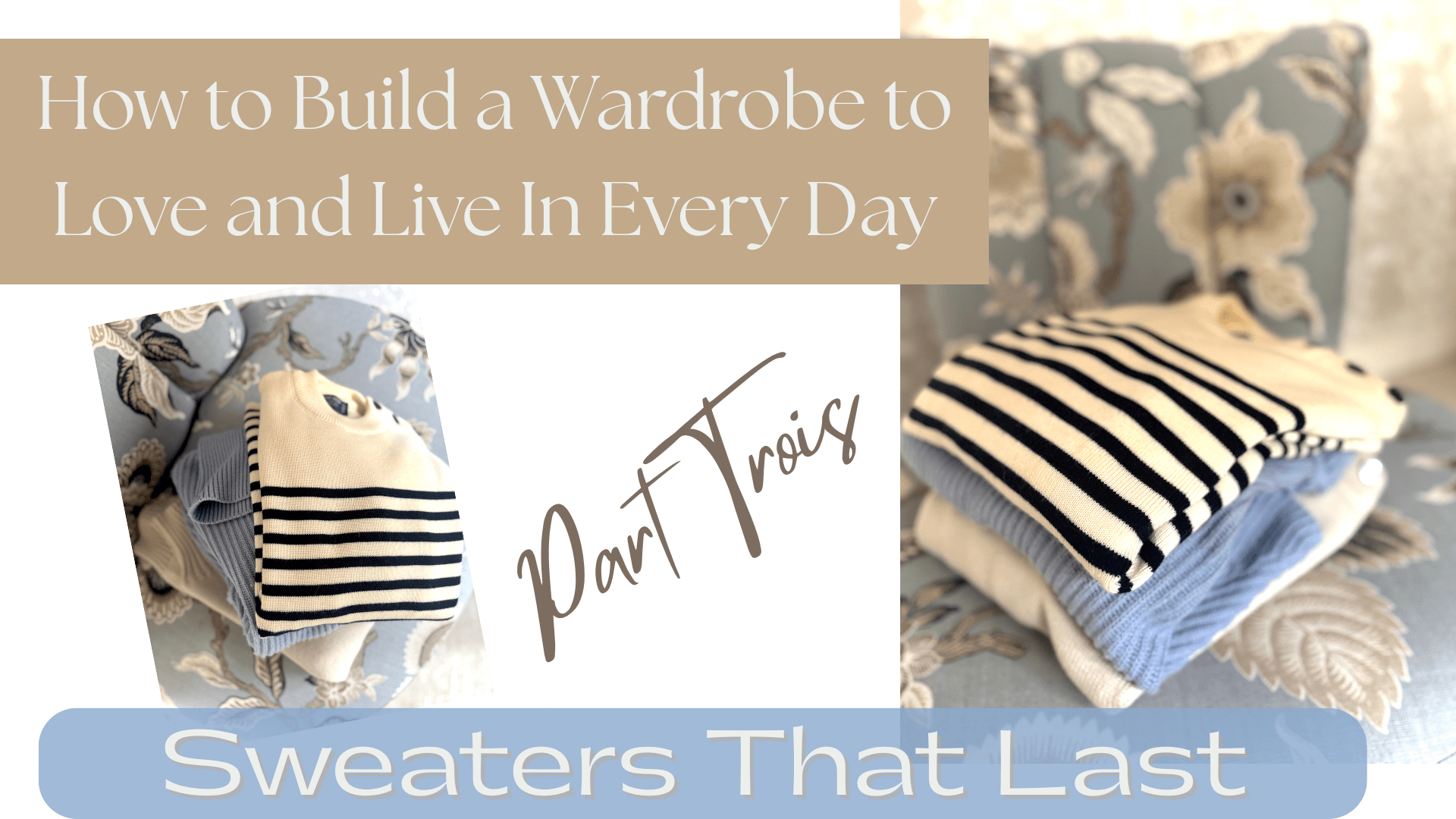
The three sweaters you see here are ones I have had for quite a few years. I love them, wear them often in the winter, and highly recommend each of the brands.

Top: St. James’s classic Breton sweater, this one is a Unisex style (shop all of their sweaters for women here); I highly recommend shopping the men’s collection for the oversized look, but also because the French sizes run small for Americans (especially this tall, long-armed woman 🙃). I purchased this sweater in Paris back in 2022, full price, but being able to try it on in person and with help from the staff, I knew the sweater I was purchasing fit me as I preferred. Made in France with 100% virgin wool, it is sturdy, yet very soft on the skin.
Middle: Joseph turtleneck sweater. This British brand is a reliable designer of high-quality clothing. I purchased this turtleneck that has a loose, oversized fit, yet hits at the waist, back in 2021 during a Black Friday sale. I had placed the item on my KarmaNow list and waited to see if it went on sale. This sweater is made of 50% cotton, 40% wool, and 10% cashmere. It is super soft on the skin, and I have only washed it once, and chose to take it to the dry cleaner.
Bottom: Jil Sander Breton style (buttons on the side of the shoulder) turtleneck sweater. Made in Italy of 100% wool, I purchased this sweater about four years ago through The Outnet, paying a significantly reduced price. It is oversized, warm, and soft on the skin.

Between these three sweaters for winter, and my new sweater from Rachel Comey, I am only in need of about one more sweater, which I will share with you later in our series this coming Autumn, when we will talk about color choices and designs (some were briefly mentioned in the list above with the styles of sweaters).
Brands of Note:
Luxury
Mid-Luxury:
- Joseph
- NavyGrey
- Another Tomorrow
- Saint James
- goop
- Eric Bompard
- Ralph Lauren‘s Polo and Lauren lines
- Aimé London
- Jumper 1234
- Eribé
- Le Tricouteur, sweaters made in Guernsey
- Rachel Comey
- Ayr
- Arch4
- La Ligne, NYC
- Brochu Walker
Great price and great quality (always check the fiber content on each design)!
- J.Crew (I still have a cotton v-neck sweater I purchased 15+ years ago that I wear and love in spring)
- Quince
- LL Bean
Admittedly, this is just a starter list, but the brands above do have quality, natural fiber sweaters available that I recommend and/or wear and love.
The series continues!
The series, How to Build a Wardrobe to Love and Live In Every Day, continues with Part Quart/Four next month on Tuesday, April 14th.
Between now and then, examine the sweaters you do have in your closet. Honestly assess how they are holding up, how often you wear them, and how you feel when you do wear them. Then, make a list of 2-3 sweaters you would like to make sure you have in your closet. Do you have these? If not, start to peruse brands and styles that speak to you. No matter their price point, put them on your KarmaNow list of favorites so that when/if they go on sale, you can check whether the new price works in your budget. Either way, you have begun to clarify what you love and what would work for your everyday life. When we purchase a quality sweater, we can prevent having to shop for it again, so keep in mind the Cost-per-Wear concept to ease your mind.
SIMILAR POSTS YOU MIGHT ENJOY



Hi Shannon:
I am loving this series! So much of what you write about is logical, if only we would slow down the rush to accumulate more instead of better. I have replaced three sweaters this winter with two cashmere and one merino wool options. I LOVE these new sweaters, not just because I took my time choosing, but because the material is so amazing. Cashmere offers warmth without the bulk and the merino wool cardigan just draps so elegantly. Thank you for your wise words on this subject.
regards,
Grace
Grace,
Thank you for sharing your experience and I am so tickled for you! Your sweaters sound lovely and as you said, taking out time will pay off and the material that we end up with is oh my goodness, true luxury. ☺️
The reminders help us all I think to be reassured not to be constantly buying and refreshing, but to buy well and be done for a good long while.
So happy to hear this series is speaking to you. Thank you again for your comment 😌
Hi Shannon, I have been thinking of sweaters over the past few winters as I wear them almost every day and have noticed that I was replacing them every 1-2 years. I have wanted to purchase sweaters that will last, but not knowing where to start or even why they were wearing out so quickly. This winter, I purchased 1 cashmere sweater from Quince so far and have worn it 3 times without washing (this concept is new to me!). Thank you for this guidance!
Marion,
You are most welcome! What good news to hear about your sweaters. We really can find them at a variety of price points. We just look for the key components, do the tests as shared and then we can purchase with confidence. And indeed, sweaters, need not be washed as often. Spot-cleaning as needed for sure, but we can give our sweaters a longer life of looking great by doing less. Thank you for sharing your experience! Quince is a great brand for fair prices on worthwhile items. 🙂
Dear Shannon, this was a timely piece as I have just managed to shrink one of my jumpers. I’m now looking for a replacement aran sweater and definitely considering the fibre! As you said, I rarely wash my jumpers so I was annoyed that I got this one so wrong and will be sticking to handwashing in the bath in the future. I’m looking forward to the next instalment in this series.
Nicola,
Ohhh! I am so sorry to hear about your sweater! That is frustrating, but I thank you very much for sharing your positive experience with having not washed your sweaters often. It is hard to change our conditioning when it comes to keeping our clothes clean, but it really is best for the sweater. May all future sweater cleanings go well and be infrequent! 🙂