Become a Member for as little as $4/mo and enjoy unlimited reading of TSLL blog.
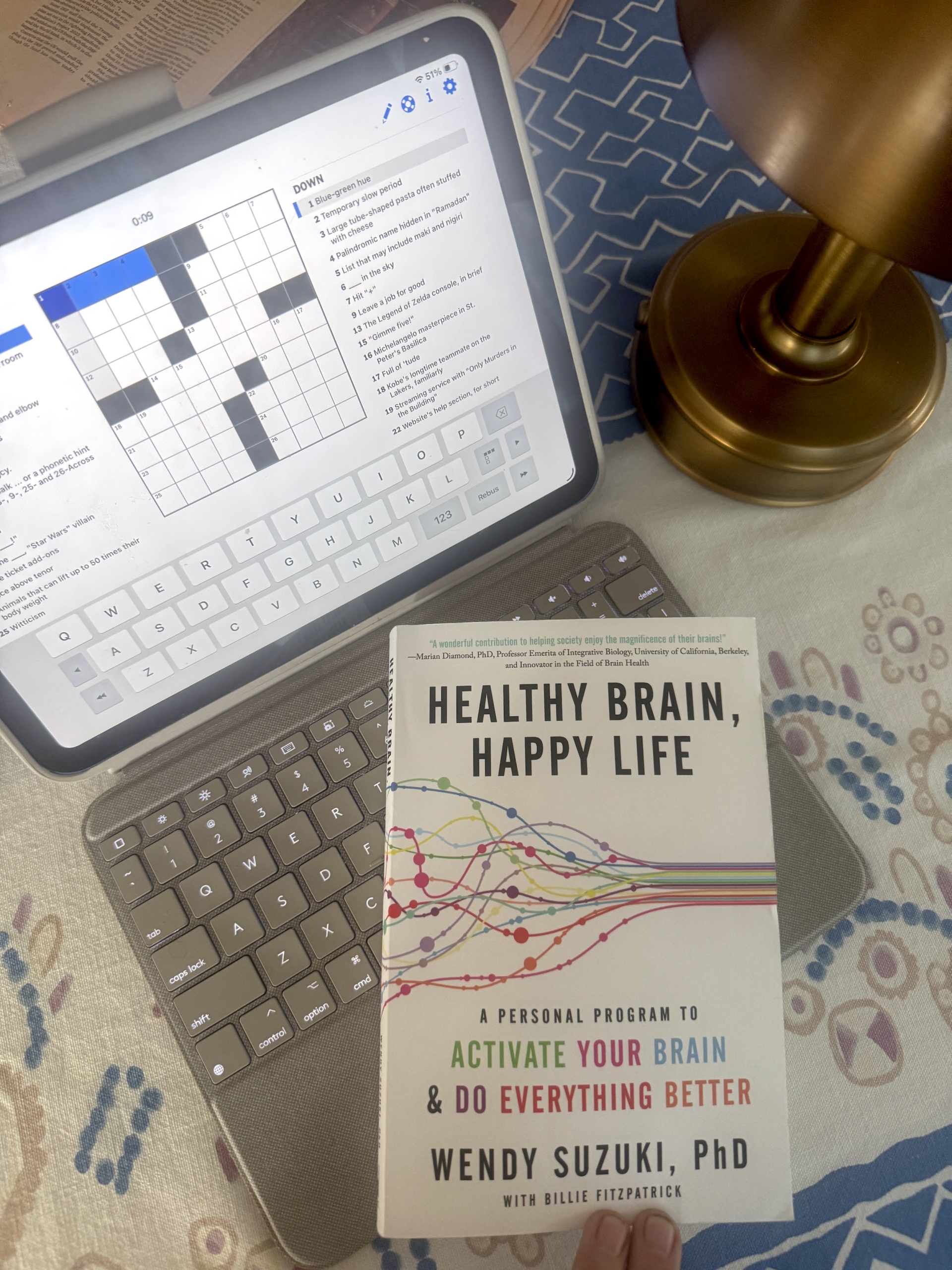
“Everything we do and for how long and intensely we do it affects our brains.” —Wendy Suzuki, PhD., author of Healthy Brain, Happy Life
We each have the ability to expand and improve the quality of our life. No matter what our age, our brain is capable of expanding in its cognitive abilities. We just need to remember to exercise it. And the beautiful discovery I want to share with you today is that often how we exercise our brain can be not only enjoyable, but elevate our entire life. A win-win in which we are the fortunate recipient that holds the keys to giving to ourselves.
In a book that came out in 2015, interactive researcher and well-known TEDx speaker, Dr. Wendy Suzuki shares in Healthy Brain, Happy Life that when we understand what plasticity means when it references the brain, “the idea that the brain has an essential ability to change as a result of experience” we open up encouragement to continue to give it opportunities to stretch, expand and discover. Which means that we are reminded that forever learning, permitting our curiosity to be our guide is not a silly prospect, but a necessary one to live a long and healthy and yep, happy life.
Today, I would like to share with you nine practices and ideas, explained through Suzuki’s shared rearch of how to keep our brain healthy and thereby enhancing the quality of our lived experience each day.
~Be sure to tune in to the audio episode as I share more details and anecdotes on each point that is listed below.
1. Learn something, anything new
Whenever we learn something new, our brain changes. How we make a new memory stick is to repeatedly recall what we have just learned. It also helps to associate the desired new information with other information. For example, speaking the language we have learned while living in the culture where it is spoken gives us a reason for needing to learn it, but also provides actual contextual situations in which that vocabulary would be used.
2. Learn a new language and then go speak it in a country where it is spoken
As we change our behaviors and experience new sensations, our brain is making adjustments as it receives this new information and responses to the new stimuli. This literally is exercising, thus expanding the brain.
3. Listen to music you love and continue to listen to it again and again
When we listen to music that prompts a strong emotional and physiological response, “the brain show[s] significant changes in the areas involved in reward, motivation, emotion, and arousal.”
4. Cultivate and intentionally live in an enriched environment
Living in a nourishing home which includes the concrete as well as conceptual aspects – encourages curiosity, play, learning, discovery as well as is full of beauty, free of clutter and makes you feel welcomed and at ease, is not a frivolous detail of life and it certainly is not a luxury as Dr. Wendy Suzuki shares through findings in studies about the brain. Studies demonstrated that “in enriched environments [the brain] results in a thicker cortex, more blood vessels, and higher levels of certain neurotransmitters and growth factors.” What does having a thicker cortex mean? More gray matter. More ‘little grey cells’ as Hercule Poirot calls them. They are thicker because they contain more nerve cell bodies, synapses, and neural connections. When these aspects of the brain increase, it has been associated with higher cognitive performance, better developmental outcomes, as well as preserved brain health.
So invest in the people, places, relationships and activities you spend your life with. Choose your community, your school, your place of work thoughtfully. Suzuki shares that her choice to study abroad in Bordeaux, France during college provided an enriched environment in a myriad of ways. Not only was she intellectually challenged having to speak and understand the French language, but the food, the music (she dated a piano tuner and they would play piano duets together) and the overall culture stimulated her mind, piqued her curiosity and encouraged her brain to literally expand.
5. Welcome in a variety of scents into your environment
“Enriching your olfactory environment with lots of different smells stimulates the growth of new brain cells in the olfactory bulb, a key part of the brain responsible for our sense of smell.” And if we are trying to increase our ability to differentiate between subtle different smells, the best way to do that is practice. Suzuki cites how the main difference between a typical sommelier (there are some that have innate smelling capabilities) and the regular person on the street is simply that they practice, exercising their olfactory bulb in the brain.
6. Exercise, challenge your body
When we exercise, studies have repeatedly shown that we boost “levels of the three key monoamines [that] play a key role in mood: serotonin, noradrenaline, and dopamine.” Monoamines are one of the many neurotransmitters in the brain, and when they are depleted, depression often is experienced. On top of increasing these monoamines, is the increase of release of endorphins. And, here goes another deep dive into my love of the origin of words: “Endorphin literally means ‘endogenous (made of the body) morphine.” So we are naturally creating a pain suppressant and increasing our happiness when we workout vigorously.
A reminder from Suzuki about when the endorphin high will be experienced: If we are just beginning a new workout, that natural high won’t be felt immediately. What is needed is expertise in the physical movement and that takes time. Be patient. So long as you are enjoying the type of workout and the environment, then you will eventual experience that high and it will then be regularly felt each time you workout thereafter.
7. Engage in Intentional Exercise
Choose an affirmation pair it with a rigorous workout you enjoy, and say that affirmation outloud (when you can, to yourself in your mind if you can’t) while you workout. At first, you will feel funny or odd doing this, but what you are doing, is connecting the mind and the body. It will boost your mood more than just exercise alone. By pairing positive affirmations with physically working out, studies reveal we are creating new neural pathways, and these pathways of positivity increase our well-being, reduce stress and shift us away from self-sabotage and negative thinking.
All an affirmation needs to be is positive, concise, and realistic in that it expresses something we value – who we want to be or what we want in our life. Examples: I am smart. I am healthy. I am capable of [name a specific outcome you have set an intention to reach]. By saying it repeatedly while we work out (and we can do this in any part of our life in our daily routine), we are creating an easier neural pathway for our brain to travel because that is what it wants to do – find the shortcut to finding ‘answers’. We make what we want to happen more accessible by creating the neural pathway before it has become our reality.
8. Strengthen your awareness of psychological stress and reduce it by focusing on what you can control
“Psychological stress develops in situations in which you feel you have no control.”
This feeling of stress becomes exacerbated when we do not have outlets to relieve our stress. This is when we have to take an honest look at life and explore where we need to incorporate healthy outlets to reduce stress. Hobbies we love – playing or creating music, crafting, gardening, dancing, meet-up groups that focus on a shared interest. This may feel as though it is pulling time away from being productive, but when we don’t reduce our stress, we actually harm our brain. If our stress is chronic, our long-term memory is affected adversely, hippocampal cells are damaged and aging actually accelerates as proteins and other metabolic machinery in brain cells is damaged.
By pushing through and refusing to relax and partake in activities we enjoy, we hinder the productivity we say we are aiming our efforts at creating. In fact, “a large body of research has confirmed that long-term exposure to high levels of stress is associated with higher levels of mood, anxiety, and addiction disorders.” So do yourself more than just a favor, but create a healthy habit of making time regularly to engage with activities that you thoroughly enjoy.
9. Become a regular meditator
Numerous studies have shared that similar to exercise, meditation increases brain size (gray matter). Also, empathy increased, attention was strengthened and anxiety reduced.
Explore each mini episode of guide meditation shared in a limtied 52-part series. The introductory post is shared below.

While reading Dr. Suzuki’s book, a book that yes, focused on brain health, I found myself enjoying and being inspired far more by this book about the brain, to actually want to take action, not only realizing that yes, these are great ideas, but actually putting them into action. Previous books I’ve read about neurology weren’t nearly as inspiring, even if they were just as informative. And the difference is the author’s inclusion of herself, sharing why she became passionate about the brain and when various ahas crossed her path as she was living an ordinary life that simply involved her following her curiosity.
At the heart of living a simply luxurious life, a life of true contentment is letting yourself be inspired by your curiosity so that you will then discover what you want to learn more about and then what you want to improve to become more expert in so that you can share with the world. The energizing effect of being delighted by what you are learning and realizing how sharing what you learn with the world to benefit others is a hard-to-describe feeling of buoyant exhilaration. That is what Dr. Suzuki does. From her studying abroad experience in Bordeaux, France, to her dating experience and workout evolution, each part of her journey reveals how genuinely curious and delighted she was by what she discovered, and I am grateful she then passed along her knowledge in this book.
May your days ahead be full of more brain exercises that elevate your everydays.
SIMILAR POSTS/EPISODES YOU MIGHT ENJOY

episode #336: How to Live a Life that Nourishes Your Brain, Thereby Elevating the Quality of Your Entire Life

Petit Plaisir
La Venue de L’Avenir (English title, Colours of Time)
Stream it on the France Channel streaming service (also indirectly, through Amazon Prime here).

Watch the Trailer below: