Become a Member for as little as $4/mo and enjoy unlimited reading of TSLL blog.
Denim for taking a leisurely walk versus denim for that dressed up affair in the middle of the day or a casual, yet professional outing in the evening. The occasions for wearing denim are vast, as well as unique to each of our lives and routines. While we may rarely wear denim in the summer due to high temperatures, the other three seasons are likely full of opportunities when we reach for a pair of jeans.
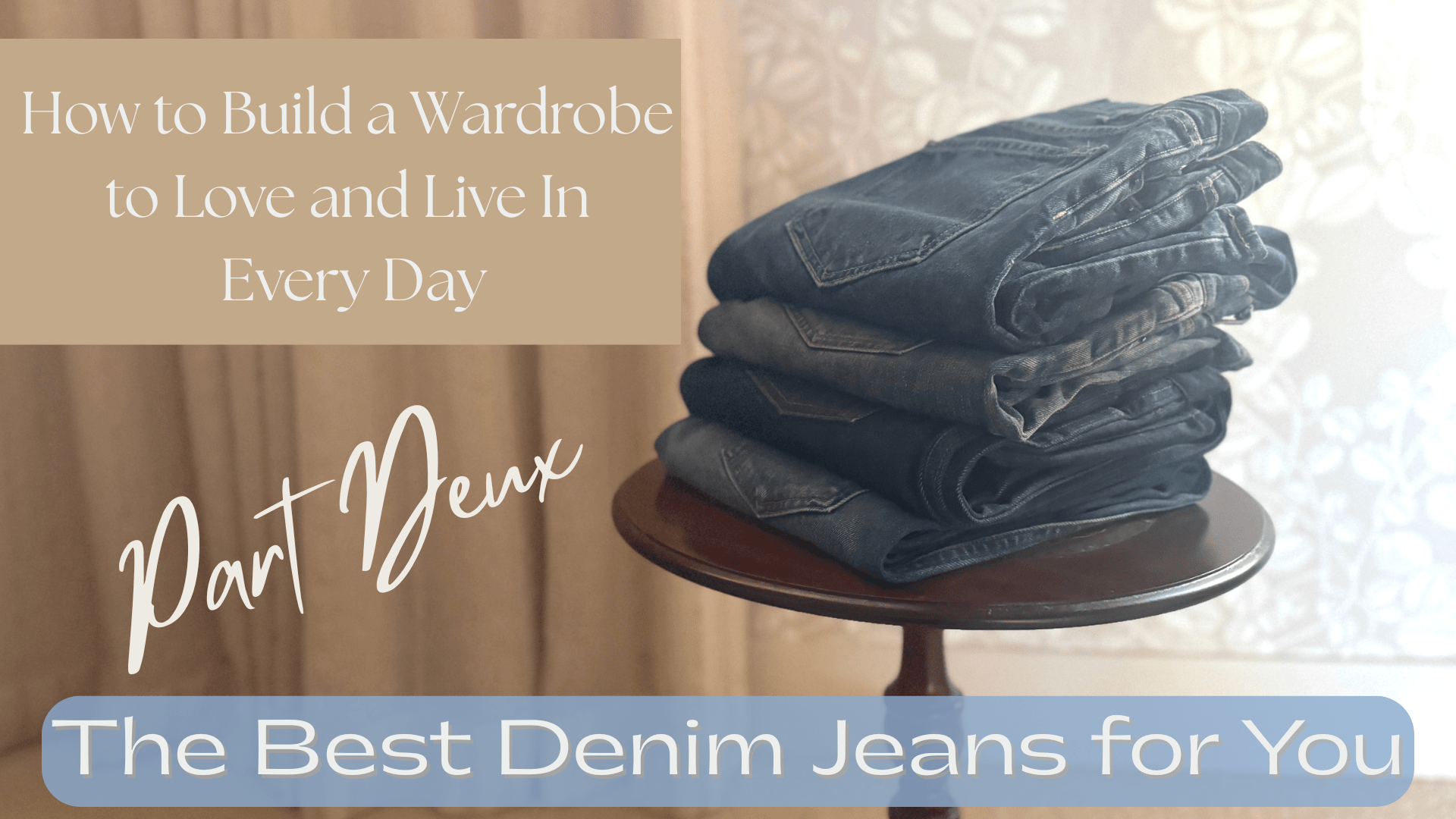
In Part Deux of our Signature Style series, I am going to encourage you to invest well in a few (2-3) pairs of denim jeans rather than having stacks of denim in your closet. Not only will this free up space in your wardrobe literally, but it will also actually save you money in the long haul because once you purchase well for your body, and make it a purchase of premium denim and craftsmanship, you won’t be shopping for denim jeans for years to come. It sounds improbable to many of us because we have become accustomed to purchasing cheap pairs, wearing them quickly, and needing a refresh too often. At first, this seems easier on the budget, but while it may take time to purchase the three investment pairs, once we have them and are wearing them, we can rest assured that shopping further is not necessary for a good long time.
So, let’s get started!
View the details of the 12-month approach in Part Une/One here.

Oh! But first, how did the first task that concluded Part Une go? If you have completed it, do you have at least one pair of denim jeans you’d like to add? Perfect! Part Deux is for you!
As we concluded Part Une last month, the suggested task to complete before Part Deux was to create the 12-15 item list based on what you need to fill the gaps in your everyday wardrobe. At the end of today’s post, I will suggest a new task pertaining to denim because we will revisit this topic it further in the series and share more details for styling. Today, we’re going to focus on which brands to shop and how to successfully find what fits you the best and will last.
I wanted to place a post about denim near the start of our series because it is a frequently worn item. Knowing how to navigate the seemingly endless options, following reading this post, will give you the tools to ensure you are making a wise investment for what you need.
Part Two: The Best Denim Jeans for You
When it comes to everyday life, many of us reach for jeans, and as this series is focused on timeless style, denim may not spring to mind as worthy of being an investment. However, I beg to differ.
As someone who has in the past had oodles of jeans, and now has only a handful (peek into my closet here), what I have learned over the past three+ decades of jean shopping is that purchasing high-quality jeans will ensure they are around for years and hold their desired shape that was experienced when we first purchased them.

With that said, making sure we purchase jeans that fit and flatter our body well is crucial. We need jeans we want to wear, that we know will both feel comfortable while looking fantastic with whatever we pair them with. And the good news is that this is possible, but first, we have to forget about a few tired limitations we may have held that guided our purchases in the past (I confess, I have been guilty of this).
First, what makes a high-quality, long-lasting-hold-its-original-shape pair of jeans?
- The type of cotton that is used. You want a long staple. This will initially make the jean feel stiffer, but it will soften with time and with that time, contour to your shape like a glove. Looking at the source of the cotton is helpful as it typically indicates the particular cotton used (more specifics are shared further below about the places to trust).
- You will know there is a long staple if you see more variations (colors) in the denim. Conversely, cotton with a short staple (short fibers) can be more uniform in color but is weaker and stretches and splits more quickly.
- Purchasing sustainably grown and harvested cotton
- “High-end cottons are usually produced in a more sustainable way anyway. You need to use fewer pesticides and take better care of the soil to produce that type of plant.” (source) As a result, this means you will pay a bit more.
- Seek out little or no stretch (i.e., rigid)
- While having a little give may be desired, knowing what the percentage of lycra (or stretch material such as spandex) should be no more than 2%. At first, this sounds like very little give, but more than that and your jeans will not hold their shape for long, nor will they last.
- If you are in between sizes, and would like to have some stretch, always size down.
- Always check the composition of the jean
- Just as you check the percentage of stretch material, check the other materials and details as well. While some denim brands have become savvy about what shoppers look for aesthetically – rivets, buttons, even the selvedge (self-edge), the two strips of fabric that run down the inside of each leg of the jeans to prevent the jean edge from fraying, be sure to confirm for yourself – check the label, look at the inside of the jean. If the brand is reputable, they will share with you all the details of the design; their transparency shares their attention and investment in detail that will last.
- Advanced dye techniques
- Further reason to invest well and purchase less is that denim dyeing is historically not environmentally friendly. However, there are new practices being used that are reducing the use of water and energy. (learn more here)
- Look at the stitching
- Italian denim brand Candiani shares on their website the importance of high-quality stitching in their denim, explaining, “One hallmark of quality is the strategic use of different stitch types. Robust chain stitching, commonly found on the outseam and waistband, provides flexibility and creates the coveted ‘roping’ effect over time. Lock stitching, with its secure, interlocked structure, reinforces areas prone to stress, such as belt loops and pocket openings, often further strengthened with bar tacks—dense clusters of stitches that act as miniature anchors. The choice of thread is also crucial, as it must withstand the rigors of daily wear and multiple washes.”
- You should also see precise and straight stitching, so take a close look to these details.
Keeping all of that in mind, now we need to find the best fitting pair for our body. Let’s take a look at what to look for when we are shopping for a pair of jeans:
- Skip looking at the traditional sizes. Don’t assuming a size ‘29’ is the same for one brand as it is another. They aren’t, and they aren’t even the same within the brands themselves as I will explain with a pair of Nili Lotan jeans.
- Look at all of the measurements and then take out a measuring tape and measure yourself today, the day you are purchasing the jeans.
- Brands have thankfully become very generous in sharing all of the details of their products (if they don’t, that’s a red flag to note)
- Look for the following:
- Front Rise (this determines whether it is low, mid or high) and where it will fit on your waistline.
- Low Hip – the widest part of the hips
- Leg Opening – where your foot and ankle will emerge
- Inseam – interior seam running the length of the leg
- Often, brands worth investing in have longer inseams, while lower-priced brands have shorter inseams. As someone who needs a long inseam, this becomes a quick indicator of quality for me. Especially if they qualify ‘long’ as 28”. Nope, that’s not long, that is short in my book. 😉
- Don’t be deterred by a too-long inseam if you need a shorter one. As you will discover with Nili Lotan, they don’t make varying lengths for their styles. Instead, they give an extra-long leg, and you can tailor it to your preference.
- Look for the following:
- I can easily buy size ’29” from one brand, and a “27” in another. It all depends on the fit you want and the style’s measurements.
- Brands have thankfully become very generous in sharing all of the details of their products (if they don’t, that’s a red flag to note)
- Composition of the fabric
- Where is the cotton from?
- Japan, Zimbabwe, Italy, US are known for providing some of the best durable, high-quality cotton in the world for denim. While other countries provide high quality cotton, cotton for denim from these four countries is a good indication of quality you can trust. But always be sure to do your own research as it is your investment.
- What percentage of cotton? If you want high quality, 100% is ideal.
- If you want a bit of stretch, choose no more than 2% elastane/lycra/spandex/etc.
- If you want stretchier than that, don’t buy a pair of denim jeans – they won’t last.
- If you want stretchier than that, don’t buy a pair of denim jeans – they won’t last.
- Where is the cotton from?
Takeaways from my purchasing experience:
- Choose a style that flatters your silhouette and provides balance to the top third of your body (most people’s legs make up 2/3 of their body vertically, but everyone is unique in their shape, so honor your body). Remember, you are breaking your body into thirds for any outfit you are putting together (something explored in my 1st book – Choosing The Simply Luxurious Life, chapter 4 – Building a Signature Style: Dress for the Life You want)
- Longer is better if in doubt, and you love everything else about the design, as you can then take it to a tailor to customize it to the length you prefer.
- The first time you purchase an investment pair of denim, you will be anxious as to whether it is worth it. However, upon trying it on, you will feel a difference – its shape isn’t wiggly, the structure and again the shape has confidence, much like a well-made dress (and so long as it is the shape and design that you want, that is what you will get dependably each time you wear it). Also, after the first wash (wash inside out and in cold water), it won’t change in shape as much, especially if it 100% cotton.
- My experience of buying a pair of Ralph Lauren denim jeans in 2022 – loved the pair of jeans when they arrived, and am still wearing them today, and loving their shape. Cost-per-wear: I have now paid only a few pennies per wear, and the cost keeps dropping.
- Choose a pair that don’t feel like sweatpants or leggings. That’s what sweatpants and leggings are for.
- Denim can be just as sharp and sophisticated as a pair of trousers. Choose a wash that creates this sophistication to pair with a beautiful blouse, suit top, blazer, or sweater, and discover the power of denim in elevated form.
- Consider which shoes or boots you will wear with each pair of jeans.
- It’s okay if you don’t have those particular shoes, but make a note to purchase them soon if you do end up purchasing that particular style of jeans.
Let’s Shop Nili Lotan Denim and other Trusted Brands
The first item I purchased as part of my one-year, 12-15 piece wardrobe investment project was a pair or Nili Lotan jeans (in early October of this past year). After having done much searching around, I discovered a high-quality approach and design as well as long lengths in a variety of styles. The reviews online from independent shoppers were positive as well, and paired with repeated recommendations from stylists, I took a closer look at this New York City based design house. Nili Lotan herself worked at Ralph Lauren and Nautica before creating her own brand in 2003. Her growth has been steady and began with a dedicated following in NYC as her designs are timeless, sophisticated, offering both functional and luxurious quality in each design. That’s right up my alley.
The brand’s collections are small, and their range of jean styles is limited, but they are classic. Nothing trendy or outlandish, but rather, a brand dedicated to giving you a quality staple in your wardrobe that you will wear for a good long time and the jean will look great the entire time.
Nili Lotan designs are transparent about their sizing being different from traditional sizing. Meaning, they have a list of sizes based on how the jean will hang on you per their envision of what that jean should look like on you – slouchy or slim, for example. Take the Mitchell style, seen below, that I purchased. The last time I purchased a size 27, I was in my early 30s. Typically I wear a 28, and in some cases 29 depending upon the brand and style. However, Nili Lotan wants this style of jean to be slouchy, so a 28 or 29 would have been very baggy, just as Nili Lotan herself models as this her preferred style of jean that she sells (see her in them here), and since I loved this cut, the wash, the rise and length, I read their sizing guide very closely and chose the size that worked for the look I was after. Preferring a slightly more fitted fit around my hips, and then the straight leg to just below the ground (the inseam is 32″), their 27 was perfect.
And that is the other detail I loved, there is no long, regular or petite; instead, they make their jeans long, and then you can tailor to what you need.


Note the brand’s label. Nearly all of the jeans are made in Los Angeles, and Japanese cotton is used for a premium pair of jeans that are durable, sturdy (rigid, but some are softer – just check the composition details). The latter detail is shared on the product page for each pair of jeans.
On my own list for our 12-month project, I have three jeans on my list, and having purchased this pair from Nili Lotan, the Mitchell, I have one more from this brand I would like to purchase as well. Further into our series, I will be sharing more details about styles of jeans and ideas for wearing in warmer months versus for example, winter. In this way, we really can wear our denim year-round, so purchasing a quality pair will ensure it will last.
Shop all of Nili Lotan’s jeans here.
Below, I have gathered up a list of denim brands organized by quality and price point (luxury, mid-luxury and budget). All of them sell timeless styles, a variety of washes, and will look great. How long they hold their shape will be determined by how they are made. As I share in the final grouping, I still have old pairs of jeans from budget brands and keep them, but no longer rotate them in my daily wardrobe. I explain more as to what I use them for.
Brands worth investing in (if the styles suite you best):
(price range $400-$700)
- Nili Lotan
- Ralph Lauren (his ready-to-wear line) (psst, yep the most expensive line from RL, but the quality is what you can trust)
- Khaite
- Veronica Beard
- (there are other luxury brands, but their price point stretches above $1000), the above options are top-of-the-line, yes, indeed an investment, but worth saving up for, and in classic styles that aren’t trendy, so you can wear them for years.
Mid-range luxury:
(price range – $200-350)
- Ayr
- Frame
- L’Agence
- Levi’s
- Rag & Bone
- Paige
- Citizens for Humanity
- Reformation
- Agolde
- 7 for Mankind
- Mother Denim
- SlverLake
- Still Here
- Re/Done
- Alex Mill
- Polo Ralph Lauren
Budget, but good; however, they will need to be replaced after 1-2 years of regular wear:
(price range – $50-199)
These brands are still brands I will purchase, or have in my closet, and they eventually become my gardening jeans as they become too stretched or too worn out for my wardrobe.
The series continues!
The series, How to Build a Wardrobe to Love and Live In Every Day, continues with Part Trois/Three — Sweaters that Last. Click here to read.
Between now and reading Part Trois, peruse a variety of denim brands, narrowing down the styles that suit your tastes. Look closely at the composition and measurements to determine the size for the styles that interest you. Then, search for reviews online by independent sources. I found this helpful to ease my mind before purchasing Nili Lotan for the first time, so I could feel confident about my purchase. Finally, decide on 2-3 pairs of jeans you would like to add to your wardrobe if denim is lacking. Once you know the price, and having done your homework, you can feel confident in your purchase when you choose to make it as it suits your budget and needs at this time. Rest assured, once you purchase what you need, you won’t be shopping for jeans for a good long while.

SIMILAR POSTS YOU MIGHT ENJOY




A really good study of denim! Quality fabrics are often hard to find in most RTW, but an investment piece or two is worth the wait. I have one pair of a light wash denim that I have worn for years, washed carefully and thoroughly enjoyed. They are comfortable. Like you, I have quite a few pair that suit me well but may not be the best in fabric quality.. This is one item of clothing that I will not construct myself. The pro’s have machines that can accurately pierce the fabric without fracturing the weave. Such a good start to the series. These two posts are a guidebooks for wardrobe building. I keep a notebook with ideas, retailers, prices etc. I add reminders if I hear about a sale too. That said, I really like the jeans you chose. A nice profile for a tall person. Because I am not tall, I have to be mindful of proportion. Happy shopping everyone.
Thank you for sharing your knowledge about how jeans are constructed. I always appreciate learning how items are constructed. Just to think about the tools, skills and intricacies helps to remove any chance of taking such a utilitarian item for granted. 🙂
I must confess that those jeans that are reserved now for gardening will be worn until holes emerge and even then until they are not suitable to wear outdoors. 🙂 Jeans are such a dependable tool in their own way with their ability to cover and move with ease for all that we need to do! 🙂
Thank you again Lucy for all that you have shared. 🙂
What a detailed comprehensive post, I love the deep dive into denim and its very specialized fabric and construction points! I come and go in phases from wearing denim and haven’t for a long time, but your post inspires me. Maybe it’s not too early to sport silk camisole and wool blazer in cream over jeans in a light wash. Currently I have the mid-price Levi’s ribcage straight from a number of years ago, which have an extremely studied and flattering fit. My work used to place me in garment fittings from time to time, and I can just picture the endless design fittings on this one. The line of the side seam on a beautifully crafted pair of jeans is a fascinating art unto itself 🙂 I think that’s how it may feel when you slip on your perfect pair, as if you’re showing up for a fourth or fifth fitting and it’s now spot on…Shannon, your post shows the way, thank you, I’ll be returning to this again and again.
Have a beautiful week, Liz
Thank you for sharing yoru positive experience with the pair of Levi’s. That is wonderful to hear. And I think you may be absolutely right about finding that perfect pair of jeans. It takes time, and often an investment, but oh, it is worth it when you find them. 🙂
Thank you for all that you have shared Liz, and your experience of working alongside garment fittings sounds quite intriguing!
Thank you for such a helpful post! I really enjoyed the information about denim and jeans composition. So will be using that when I come to search.
As a petite person – very short legs 😭 – it has always been hard to find jeans that fit well at the right length and balance my body. In the last couple of years I have purchased some denim from Reiss’s petite range and found it to be quite good! I also feel that boot cut styles suit me best, as I have wider hips/bum and smaller waist and ankles. However I always struggle with what shoes I would wear day to day if I was to always wear these style.
I need to revisit the first post! And think about footwear to add this year.
My first purchase of quality was a new leather skirt. I had one some time ago and the donated it as it didn’t fit as well anymore, and I regretted that in the last few years. As I found it to be such a great basic that I could wear more casually with a jumper and boots, or more dressed up or formal if paired with a silk shirt or heels and blazer.
I think I will try on and review my denim collection and consider where there might be a gap. (Also 100% also use my old jeans for the garden 😅)
Thank you for another informative and helpful post
Sarah
Sarah,
I apologize for the delayed response. I missed this comment and that is my error.
Thank you for sharing all that you have, especially your experience with Reiss’ petite designs as they offer so many options in each style they design in both regular and petite, it is good to know of worthwhile sources fellow readers can trust. And I trust your recommendations. 🙂
Regarding which type of shoe to wear with bootcut. I find that a 1” boot with a block heel (not stiletto) is a casual, yet dressed up enough choice that lifts the leg so that the wide leg opening doesn’t sit heavily near the ground. Sneakers are okay, but a narrower leg opening would look a bit better – such as a straight-leg. Essentially, straight down from the knee (not wider or narrower) creates a nice line and can be worn with heels of any height or sneakers. I am definitely not a fan of flare for this reason, it is not slimming to the leg. I hope this helps a bit.
Thank you for sharing your experience with your leather skirt. Isn’t that the way sometimes – we need to not having something to realize how valuable it is in our closet options? But now you know! And comparably, a small price for a great lesson to learn. Thank you for sharing what you paired it with that worked well for you dependably.
I hope you were able to find a brand or two that spoke to you (and tickled to hear you too transition old jeans to the gardening wardrobe! 😉 I find that once I do this, the first thing to go is the knees as I am always digging in the dirt, low to the ground. Thankfully, holy knees is okay when it comes to gardening denim ;)).
Thank you again for your comment.
Great post, Shannon! Jeans are so difficult, aren’t they? It was hard for me to find a style that works well with my body type. I’m 5’4″ (shrinking as we age is REAL), 140-145 lbs, and hourglass shaped. I despise low waist jeans. 🙂 Several years ago, I came across Wit & Wisdom’s Itty Bitty Bootcut jeans and found my perfect match. They have a bit of stretch, and the bootcut is understated and perfect for my shape. Despite the low-end price of $88 at Nordstrom, I’m still wearing my first-ever pair I’ve had for years. They launder beautifully. I have three pairs in different washes. It looks as if the “itty bitty” has been replaced by “baby,” and I do hope that only the name has changed. I am tempted to look at higher-priced brands, but given my happiness with this brand at its low price point, I’ll likely save more of my wardrobe dollars for other pieces.
Hi Ellen, and I apologize for the delayed response!
Thank you for sharing all that you have and specifically a brand you found that works for you. You will help others to give them ideas of where they might want to shop as well. 🙂
That is such great news to hear that these jeans are lasting well! And what a great idea to purchase multiples once you find what you love. A great tip to remember. And since you have found what you love and fits well for you, most definitely save the dollars for other items. You’ve found your denim jeans source! 🙂 Thank you for sharing all of this. 🙂